3D survival RTS
Kiengi Chronicles
Several Tribes fight over a Region of Kiengi. Those who learn to live alongside the species that inhabit it tame them and put them to use; those who wipe them out find the Predators in their Village.
An RTS close to Age of Empires in its economy, Village levels and battles between Tribes, set on a planet where the dinosaurs never went extinct and even the Hominids are reptiles. The difference is the fauna: the dinosaurs are a neutral third force that reacts to how each Tribe treats them.
Coexistence is a weapon
Every Tribe pays for how it treats the dinosaurs: those who hunt too much suffer Incursions, those who coexist tame. You can win by Balance, not just by Conquest.
A living ecosystem
Species have Territories, finite Herds, Hunger and routines even when nobody is watching. Predators eat Prey and leave Carcasses.
A readable economy
Few resources, short chains, status always in view. Food, wood, stone, flint and bones, and from M10 obsidian, rare and contested.
30–60 minute Matches
Skirmishes of 2 to 8 Tribes split into Teams. The Tutorial and the Campaign are Missions built on top of the Skirmish.
Where to start
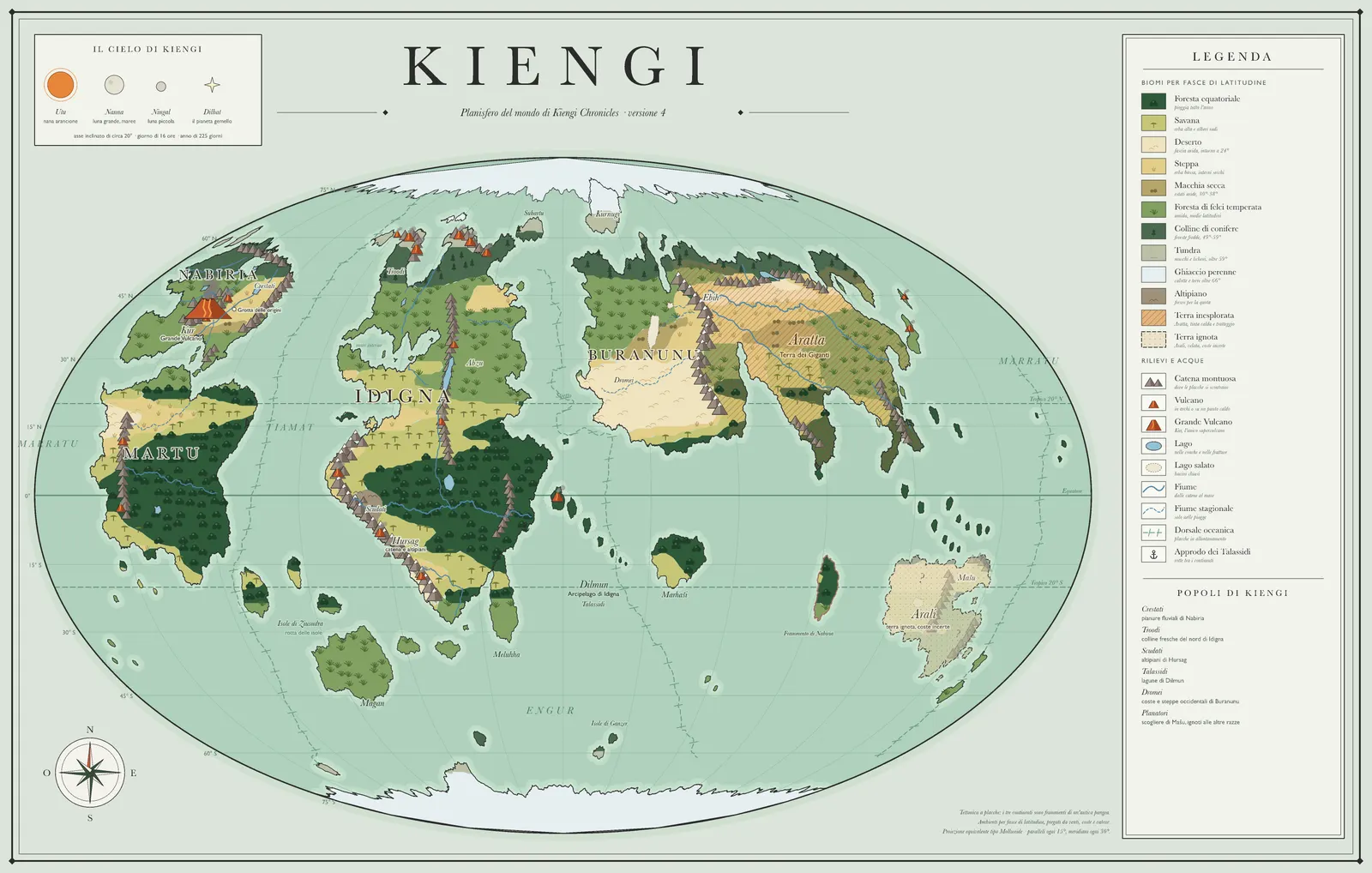 The worldKiengi, its orange star, the two moons and the four continents born from an ancient pangea.
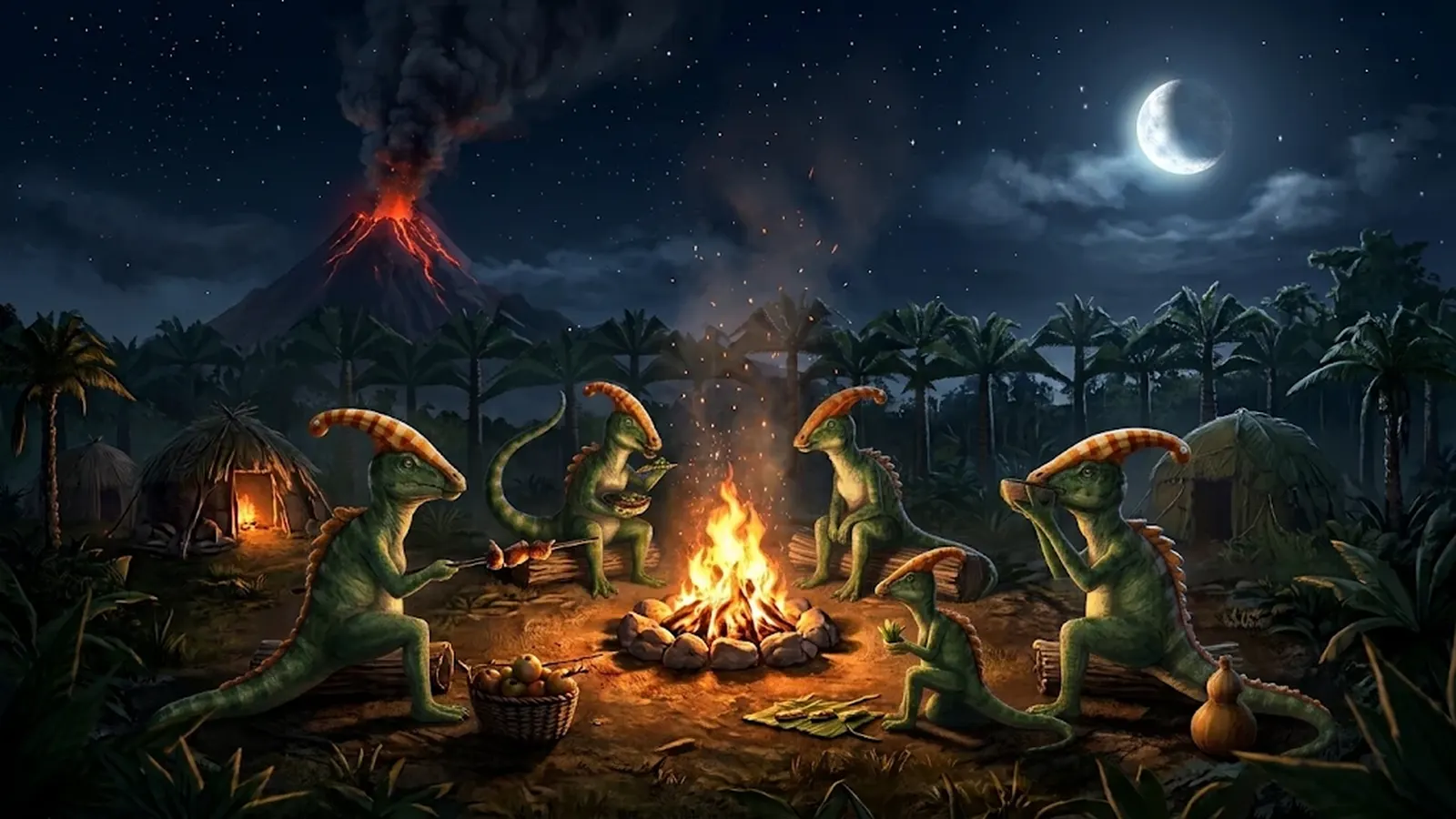 Deep historyFrom the great eruption of Kur to the First Clutch in the caves, up to the fire carried outside: the truth of the Chroniclers, which no people remembers.
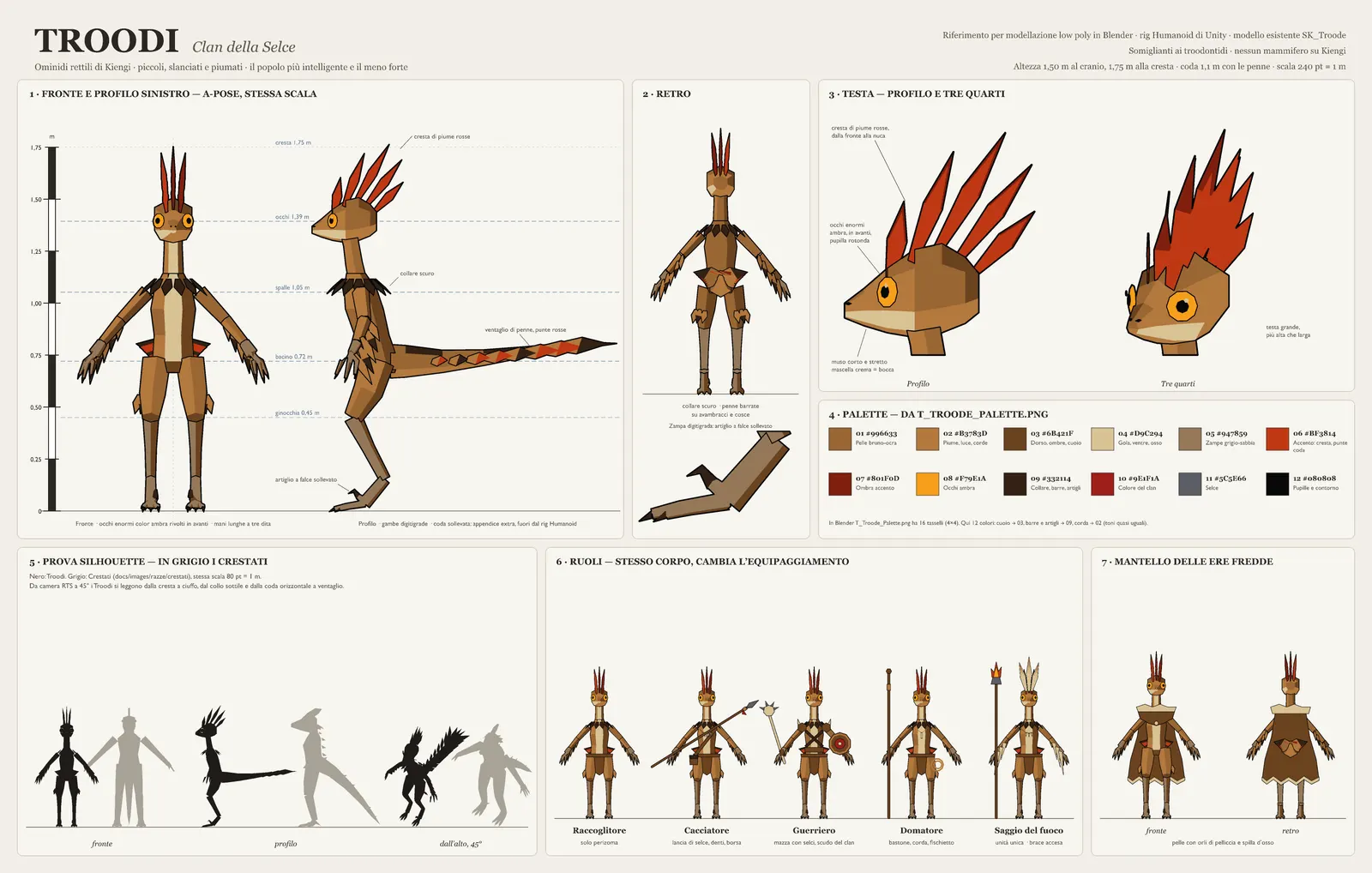 The peoplesFive reptilian Races from a single lineage, each with its own bonuses, myth and silhouette.
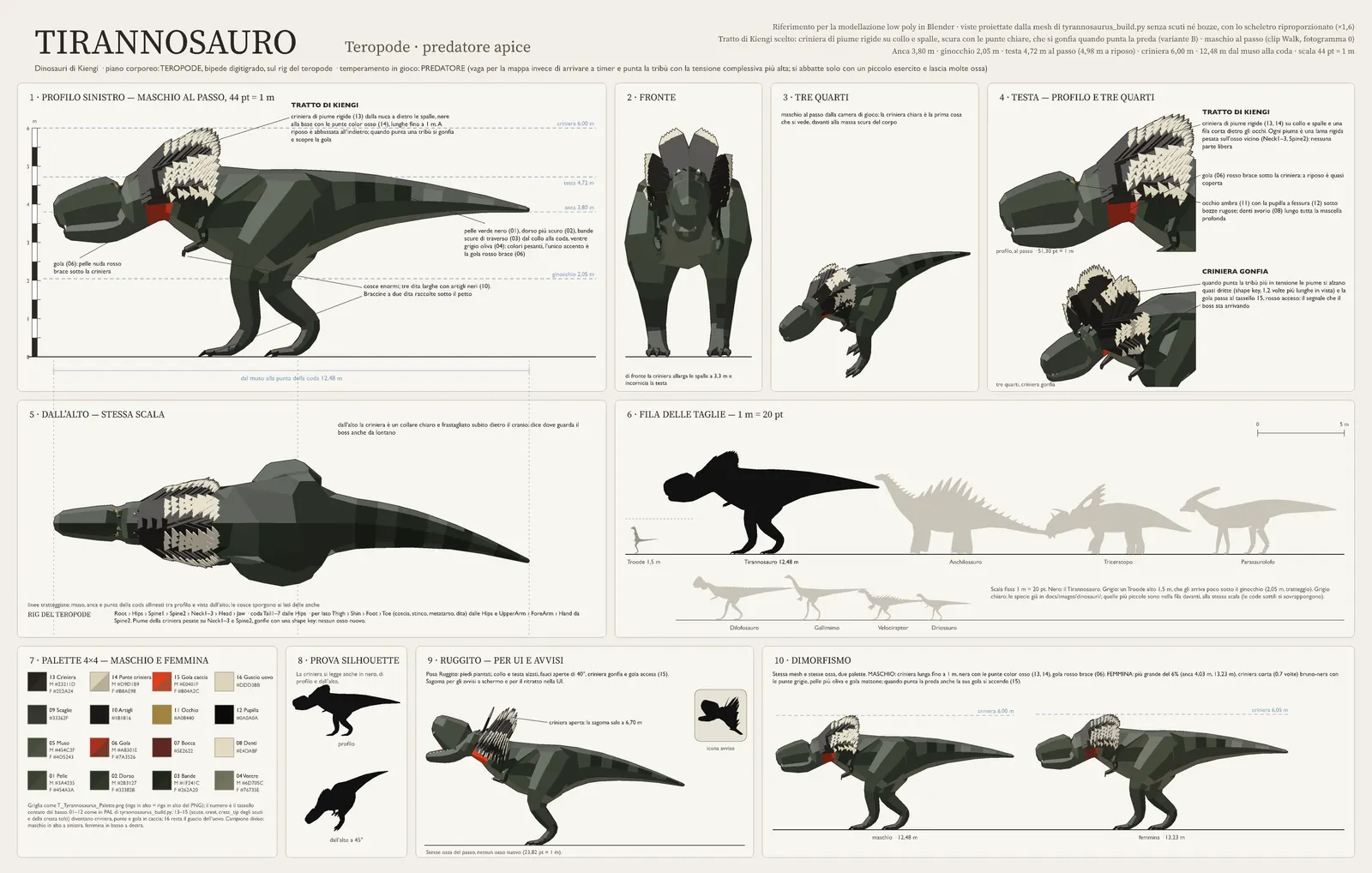 The faunaEight species in the MVP, eight from Arali and the Flyers of every Map, each with a trait its earthly relative lacks.
 TensionThe mechanic that sets the game apart: a value from 0 to 100 for each species–Tribe pair.
In a Match
Each Tribe starts from a Camp with three Hominids. You gather, build Huts, rise in level from Bivouac to City and fight the rival Tribes, as in Age of Empires. Meanwhile every hunt, every tree cut in a Herd's Territory and every Offering of food shifts the Tension between that species and the Tribe. Above 70 the Incursions come, below 30 you can tame. You win by tearing down all the enemy Camps, or by keeping the Sanctuary standing with every species at peace with your Tribe.
References: Age of Empires II for economy and ages, Northgard for seasons and events, They Are Billions for pressure and defense, Banished for survival. Initial platform: PC (Windows and macOS) with mouse and keyboard.
The world
Kiengi
The planet where the dinosaurs never went extinct
Kiengi is not Earth. Life formed there in a similar way because the conditions are similar, liquid water and an oxygen-rich atmosphere, but it took its own paths. Mammals never appeared and the Hominids themselves are reptiles. The species draw on earthly ones without being copies of them: Triceratops and Velociraptor are working names.
The sky
Utu is cooler and longer-lived than the Sun: warm light, orange sunsets and a bright green sky. Its stability gave life billions of years to reach intelligence. Two gas giants on the outer orbits deflect comets and asteroids as Jupiter does, and that is why the dinosaurs never went extinct on Kiengi. Two rocky planets orbit in the habitable zone, Kiengi and Dilbat; three more lie outside it.
The lands
Four continents separated by oceans, Nabiria, Martu, Idigna and Buranunu, plus a fifth land that no Race has ever explored. They are fragments of an ancient pangea, broken apart tens of millions of years before the First Clutch: the coasts that face each other match roughly (the boot of Nabiria fits into the northern bay of Martu, the peninsula of Martu into the gulf of Idigna), and that is why the same groups of dinosaurs live on all the continents. No Race knows about the pangea.
| Land | Where | Environment | Who lives there |
|---|---|---|---|
| Nabiria | west, from 55° to 25° N | The smallest continent and the cradle of the first bipeds. Conifers in the north, temperate fern forests in the middle, many rivers and lakes. Around 40° N rises Kur, the Great Volcano, with the mountains of the caves of origin. | Crestati |
| Martu | south of Nabiria, from 30° N to 20° S | Almost as big as Idigna, beyond a strait of about 300 km. Savannas and steppes in the north, in the arid belt; equatorial forest in the middle and south. On the west coast a range with two volcanoes, from which a great river flows east. | no people: it is the land of a predator that hunts the Crestati |
| Idigna | center, from 60° N to 25° S | The largest continent. Conifer hills and an arc of volcanoes in the north; in the middle the arid belt with Abzu, the great rift lake; in the south the equatorial forest and the Hursag range. | Troodi in the north, Scudati in the south |
| Dilmun | archipelago of Idigna, from 0° to 15° S | Tropical volcanic islands on a hot spot, sheltered lagoons, the strong tides of Nanna. | Talassidi |
| Buranunu | east, from 50° to 10° N | Vast and far from the cradle. Steppes and savannas in the west with seasonal rivers and salt lakes; the Ebih range cuts through it from north to south. Beyond the range lies Aratta, the Land of Giants. | Dromei on the coasts and in the western steppes |
| Arali, the unknown land | southeast, from 10° to 40° S | A crescent around a deep gulf, with the Mašu massif in the middle, a dry interior with a salt lake and the humid coast around the gulf. The first to break away from the pangea, it is the refuge of the world before: archaic species extinct elsewhere live there. On the chart it stays veiled, because the five Races do not know it. | the Gliders, a sixth Race that nobody knows |
The «Who lives there» column says where the main Tribe of each Race lives, the one its Chapter follows in the Campaign. The Races move and migrate like the peoples of Earth: Troodi, Dromei, Crestati and Scudati have Tribes scattered across the world, which meet by land and by sea, while the Talassidi and the Gliders stay only in their own lands.
Aratta, the Land of Giants, is the interior of Buranunu beyond the mountains, never touched by the Hominids: larger species absent elsewhere, Sauropods and giant Flyers, which have never met a Hominid and start with no Tension toward any Tribe. For the Talassidi it is a legend glimpsed along the routes of the marine reptiles. It can only be reached by sea along the coast and stays outside the Campaign: it appears only as a legend and as the destination of the Escape ending.
Climate, relief and waters
As on Earth, environments follow latitude: humid forest at the equator, arid savannas and steppes between 15° and 35°, temperate forests at middle latitudes, cold conifers near the poles and then the ice caps. With the 16-hour day the bands are a little narrower. The trade winds blow from the east below 30°, the westerlies between 30° and 60°, and the ranges drop their rain on the windward side.
The ranges lie where plates collide. Kur is a supervolcano on a hot spot, like Yellowstone, and it is the only "great" one on the planet: its eruption nearly wiped out life. The oceans are few: Marratu, the outer ocean; Tiamat, the sea between Nabiria and Martu to the west and Idigna to the east, about 3,000 km wide; Engur, the southern ocean; between Idigna and Buranunu the Strait, about 2,500 km. Martu is about 300 km from Nabiria and 2,600 km from Idigna.
Crossing the seas
There are no land bridges between the continents, only open seas with ridges. You cross by sea, on rafts and later on boats, from one land to another. In the glaciations the sea drops, more islands and shallows surface and the stretches to cover get shorter; when the ice melts the low islands vanish and the crossings grow longer. Glaciations, eruptions and rising seas do not mark out Eras: in the game they are events of a Region or of a Mission.
- The island route runs from the south of Martu, passing below Idigna, up to its tip: the islands of Ziusudra, the first on the Tiamat ridge, and Magan, the largest island, between 32° and 45° S. The stretches of sea between one land and the next are between 400 and 1,000 km long.
- The polar route starts from the northeast cape of Idigna: Subartu is less than 100 km away, then about 1,200 km of sea lead to Kurnugi, the polar island beyond 60° N, freezing and home to a fierce fauna, and another 550 km to the north coasts of Buranunu.
- In the southern hemisphere, almost all ocean, there are also the fragment of Nabiria off Buranunu, Meluhha, the long island east of the tip of Idigna, Marhaši, the round island east of Dilmun, and the islets of Ganzer in front of the southern ice cap.
Names of Kiengi
Every place has a single name, valid for all the Races, of Sumerian or Akkadian root. In texts and in the UI the name comes with the common one beside it: "the Great Volcano, Kur", "Aratta, the Land of Giants".
| Name | What it denotes | Origin |
|---|---|---|
| Kiengi | the planet | Sumerian ki-en-gi, Sumer |
| Utu | the star | Sumerian, the sun and its god |
| Nanna | the large moon | Sumerian, the moon god |
| Ningal | the small moon | Sumerian, the "Great Lady", wife of Nanna |
| Dilbat | the twin planet | Akkadian, Venus as the morning and evening star |
| Nabiria | the continent of the cradle | no real origin: it is "the name from the caves", born before the language that named everything else |
| Idigna | the central continent | Sumerian, the Tigris |
| Buranunu | the eastern continent | Kiengi form of the Sumerian buranun, the Euphrates |
| Kur | the Great Volcano of Nabiria | Sumerian, "mountain", "foreign land" and "underworld" |
| Hursag | the range in the south of Idigna | Sumerian ḫur-saĝ, "mountain" |
| Abzu | the great rift lake of Idigna | Sumerian, the abyss of fresh water |
| Dilmun | the archipelago of Idigna | Sumerian, the land beyond the sea |
| Ebih | the range of Buranunu | Sumerian, the range struck down by Inanna in the myth |
| Aratta | the Land of Giants | Sumerian, the distant, rich land beyond the mountains |
| Marratu | the outer ocean | Akkadian, the "bitter river" of the Babylonian map of the world |
| Tiamat | the sea between Nabiria and Idigna | Akkadian, the primordial salt sea |
| Engur | the southern ocean | Sumerian, the underground waters |
| Martu | the continent south of Nabiria | Sumerian mar-tu, "the west", the land and peoples west of Sumer (in Akkadian Amurru) |
| Islands of Ziusudra | the row of islands between Martu and Idigna, on the island route | Sumerian, the hero who survives the flood in the Sumerian tale; the name is usually translated "life of long days" |
| Magan | the largest island of the island route | Sumerian, a distant land reached by sea, named with Meluhha and Dilmun in the inscription of Sargon on the ships moored at Akkad |
| Meluhha | the long island east of the tip of Idigna | Sumerian and Akkadian, the farthest of the lands reached by sea |
| Marhaši | the round island east of Dilmun | Akkadian, a distant region in the east, beyond Elam, from which precious stones and rare animals arrived |
| Subartu | the island in front of the northeast cape of Idigna, first stop of the polar route | Akkadian, the north, one of the four quarters of the world around Akkad |
| Kurnugi | the polar island, freezing and home to a fierce fauna | Sumerian kur-nu-gi4-a, "the land of no return", in Inanna's descent to the underworld |
| Ganzer | the subantarctic islets | Sumerian, the palace at the entrance of the underworld |
The world
The Chroniclers
Those who write the chronicles of the title
The Races of Kiengi do not write and do not know what lies beyond the sky: the sun and the moons, for them, are myths. But someone watches them from above, keeps track of their stories and writes their chronicles: they are the Kiengi Chronicles of the title. Nobody knows where they come from or since when they have existed. They have no time: they know everything about Kiengi, from the beginning. Their only purpose is to gather and document life in the universe.
The rules
- They never appear: they have no name of their own and no body, and no Race perceives them.
- They only observe: they never intervene, for any reason.
- They exist only in their texts. In the Campaign you hear them: a voice reads the Chronicle at the start of every Mission, in a language nobody understands, with subtitles in the player's language. It is the Chronicle being read, not a Chronicler appearing.
- The Chronicle tells things in the order in which the Tribe comes to know them: the Chroniclers know everything, but they do not say it right away. No people knows the origins or the kinship between the Races: the player discovers it only in the last Chapter, the one of the First Ones.
- It is never said who they are, where they come from or what they once were.
What they explain
- Earthly words: "dinosaur", "Triceratops" or "Troodi" are not words of the Races, but labels of the Chroniclers. It is not clear where their language and their names come from: the resemblance to earthly ones may be a coincidence, or perhaps they once existed with us too.
- A single name for every place: distant Races, with no way to talk to each other, could not share one. It is the name from the Chroniclers' atlas, with the exception of Nabiria, the name gathered from the Races themselves.
- What no Race knows: the pangea and the sheets of the planet are written from an outside point of view, theirs.
- The Chapters of the Campaign: one per people, they are the files of their archive. They do not say when they happened or in what order: only the Chroniclers know, and they have no time.
- No magic: on Kiengi physics governs everything. For the Tribes magic exists, because they do not know science; the Chroniclers know the real phenomenon.
- The presentation: sheets, species cards and loading screens may be pages of their archive, and the camera from above echoes their gaze.
The player
The player is not a Chronicler, because someone who only documents does not give orders to a Tribe. The Chroniclers are only the frame: you guide the Tribe while the Chronicle is read, the endings are possible closing pages, and a defeat is "that's not how it went", after which the Mission restarts.
The world
Deep history
How small reptiles in caves became Hominids
It is the truth of the Chroniclers, and no people knows it: the Races do not write, and of the origins only myths and legends remain, which do not agree with one another. The player gathers the fragments Chapter after Chapter, and sees it whole only in the last one, the Chapter of the First Ones.
The great eruption
In a time long gone Kur, the supervolcano of Nabiria, erupts. The dust darkens the sky, the land turns sterile and life on the planet comes close to extinction.
The caves
A few small reptiles resembling Sauropods find shelter in the caves among the volcanic mountains of Nabiria. There the ground is warm, the air humid and full of insects, and the warm soil broods the eggs in their place.
The First Clutch
In an environment that is entirely warm the cold-blooded body no longer needs to stay in contact with the ground. They rise onto their hind legs, the tail becomes a counterweight, the front legs become grasping hands, and in the dark large eyes and brains grow. Many generations later they are Hominids in every respect: the First Ones, as the Chroniclers call them.
The return of life
The dust settles, the sky turns green again and the vegetation blooms anew, starting with the ferns. But the other species have adapted too: new super predators are born, and to them the Hominids are easy prey.
Fire
Outside the caves the ground no longer warms the eggs, and without heat the mothers fall into lethargy. Whoever learns to carry the heat with them, that is fire, can leave the slopes of Kur. From that moment intelligence becomes the decisive advantage.
The Races
Here the deep history falls silent: how and when the descendants of the First Ones spread across the world, no Chronicle tells. Like the peoples of Earth, the Races of Kiengi are many, they move and migrate, wage war and trade, and each has taken on traits suited to its land. Different Races do not interbreed, so a Race that shrinks in number ends up disappearing; and with no means to communicate, a Tribe that settles far away no longer has news of the others. That is why the end of a people is its end in one land, not necessarily in the whole world: the Chroniclers call it the Vanishing.
No one remembers
Without writing the origins have been lost: each Race has its own contradictory myths, and the Dromei have forgotten them entirely. No people discovers the kinship between the Races; the player does, at the end of the Campaign.
Myths of origin
Every myth keeps a true fragment of the deep history and distorts it. No people puts them together: the player does, Chapter after Chapter.
| Race | True fragment | Distortion |
|---|---|---|
| Troodi | the cave and the fire | they believe themselves the only ones born in the cave and the only true children of fire |
| Crestati | they have always lived beside the herds of the great herbivores | they believe they descend from them, which is why they venerate them as ancestors |
| Scudati | the great eruption and the death of the world | in the Bone Piles they see the dead of that end and guard them |
| Talassidi | the rising sea | they believe they came from the sea, carried by the marine reptiles |
| Dromei | nothing | they believe they were born of the steppe and the hunt |
| Gliders | to be decided with their Chapter | they do not remember the origins, like the other peoples |
The only element present in all the myths is the fern, the first plant to return after the great eruption: it is the first clue to the common origin. The proof is the cave of origin on the slopes of Kur, in the Territory of the Fern Keepers, who hold it taboo and do not grasp its meaning: paintings of the First Clutch on the walls and fossil eggshells in the warm soil.
Myths and legends
The Races are young: they live by hunting and gathering and do not know writing. Myths and legends are passed down by word of mouth and change a little with every telling. They travel with the merchants, who besides goods carry the stories heard in the places they visited: that is why, unlike the myths of origin, which every Race keeps for itself, they belong to all the Races, each with its own version.
The genesis of the great worlds
It is the oldest myth of Kiengi. It arises among the Scudati, the people who remember the great eruption, and the merchants have carried it to all the Races.
Every evening two great worlds appear in the sky, one white and shining, the other smaller and reddish: they are Nanna and Ningal, the keepers of time and of the great sphere that brings life, Utu. Once Kur, the lord of fire, abducted the great sphere, and without it life withered. Then two brothers, great heroes of their Tribe, climbed the slopes of the great mountain of fire, defeated the lord of fire and confined him in the bowels of the earth. So that nothing could ever happen to the sphere again, they took their place in the heavens beside it, and have kept it ever since. The lord of fire, however, has not given up: that is why flames and the red sea still come out of the mountain.
| In the myth | On Kiengi |
|---|---|
| the great sphere that brings life | Utu, the star |
| the two great worlds, the brother keepers | Nanna, the large moon, white; Ningal, the small moon, reddish |
| the great mountain of fire | Kur, the Great Volcano of Nabiria, which bears the name of its lord |
| the bowels of the earth, where the lord of fire is confined | the heart of Kur, still active; the red sea is the lava |
| the abducted sphere, the life that withers | the great eruption: the dust darkened Utu and life nearly went extinct |
Like the myths of origin, it keeps a true fragment and distorts it: the great eruption becomes the abduction of the sphere, and the return of the light when the dust settled becomes the victory of the two brothers. The Scudati do not know where the great mountain of fire is: it is the name of the lord that, in the merchants' versions, passed to the Great Volcano of Nabiria. From this myth come the gods of all the Races, each with its own part at the center (see Beliefs).
- Merchants' stories: the Caravans bring back legends from the Markets they reach, and the Tribe gathers them like the fragments of the myths of origin.
- The wrath of Kur: eruptions are told as the lord of fire rebelling.
- The moons in the sky: at Night you can see Nanna and Ningal, in the scene and on the Clock.
The world
Beliefs
The fern, the fire and the gods of every race
The fern
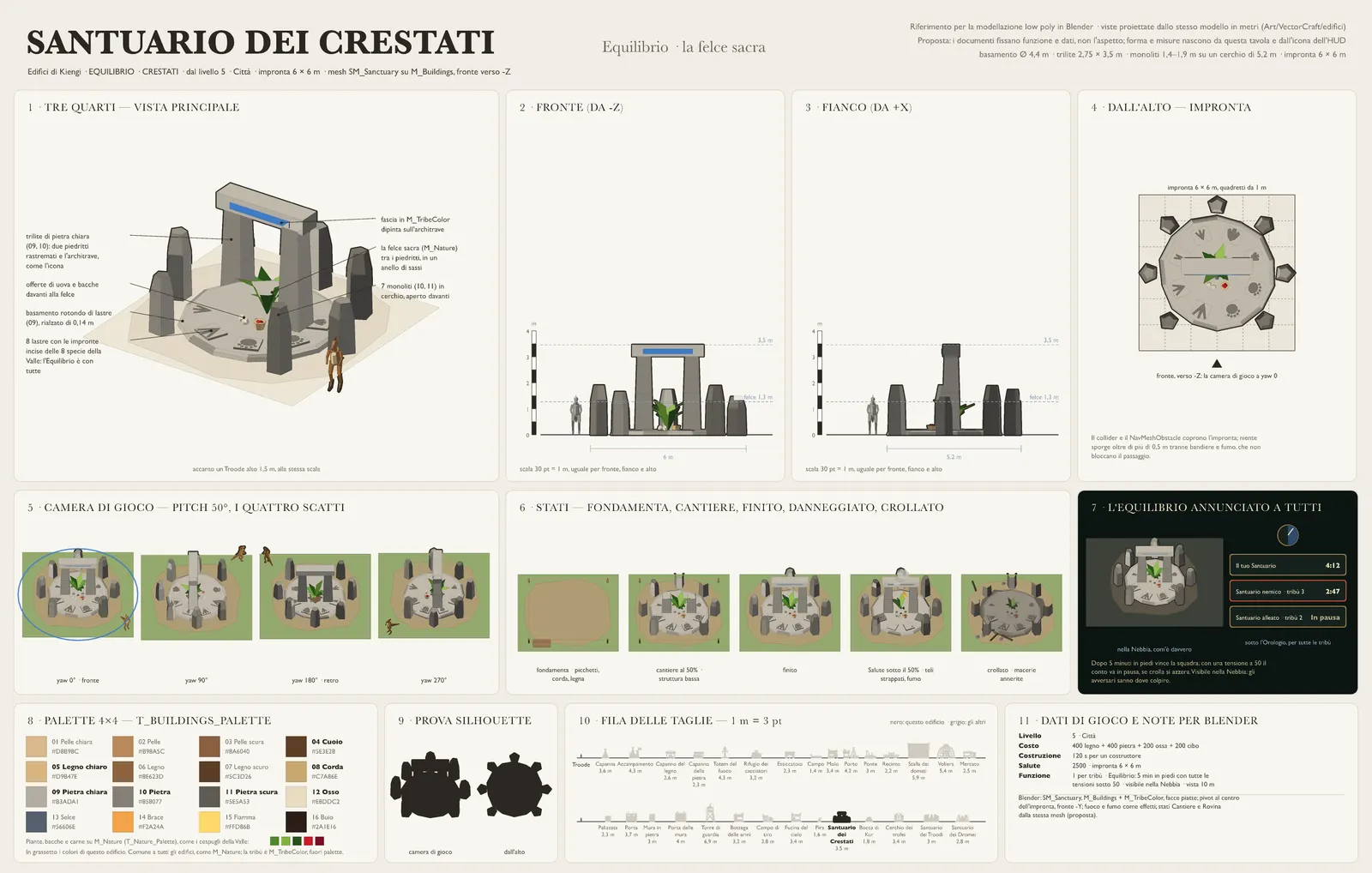
It is the symbol all the races share in their myths, because it is the first plant that came back after the great eruption, and so the rebirth of the world. It is not a shared symbol of worship, though: every race has its own Sanctuary, and the sacred fern stands at the center only in the one of the Crestati, the Fern Keepers, between the posts of a trilithon and with the footprints of the species around it.
The fire
Fire is the warmth of the cave carried along, and it incubates the eggs as the warm ground used to. In the village it takes three forms:
- The Camp bonfire is the hearth of Hatching, where new Hominids are born, and it keeps the raptors away at night.
- The Fire Totem is the sacred fire of the Tribe, lit from the fire of the mother Tribe.
- The Pyre is a travel fire lit from the Totem, for stopping at night far from the village.
The Troodi claim that their fire has never gone out since the time of the caves.
Religions
Religions exist and are widely practiced, with deities that reinforce the myths, rites, priests and sanctuaries. The pantheon is shared, because it travels with the merchants along with the myth of the genesis of the great worlds: Utu, the great sphere and mother of life; Nanna and Ningal, the guardian siblings; Kur, the lord of fire. Each race puts a different part of it at the center, the one closest to the true fragment of its myth of origins.
From the Shaman to the cults. In the Campaign there are Tribes with only a Shaman, still to be designed, and peoples with real religious cults, which open new technologies and serve to tame the beasts, even those that cannot be tamed today. No magic: whoever tames with faith does it with real gestures, offerings and knowledge. Which peoples have the Shaman and which the cults, in a Campaign with no timeline, and how they tie into the Sacred Places and Sanctuaries of the Skirmish, is for the grilling on religion to decide.
Cults of the races
Each race has its own deity at the center, its own priests and its own rites, a Sacred Place that you build from the Village and a Sanctuary of its own for the victory by Balance.
| Race | Deity at the center | Priests | Rites |
|---|---|---|---|
| Scudati | Nanna and Ningal: the two siblings were Scudati heroes, because the myth was born among them | Keepers of the bone piles | they bury the bones and watch over the dead of the great eruption |
| Troodi | Kur, ambivalent: the fire of the earth incubated the first eggs in the cave and is life and destruction together. They honor him and appease him, and the other peoples distrust them for it | Fire Sages | they light every new fire from that of the mother Tribe and feed the embers that appease Kur |
| Dromei | Kur, strength: they have forgotten their own origins, and of the merchants' myth they admire the lord of fire who never gives up. It is a cult of strength, which sets them against the other peoples | trophy bearers | they offer Kur the trophies of the hunt |
| Crestati | Utu, the mother of life, and the great herds as ancestors | Callers | they sing with their crests at the rising of Nanna. The cave of origins, on the slopes of Kur, is for them the gate to the bowels where the lord of fire is shut in: it is taboo, and so they do not grasp its meaning |
| Talassidi | Nanna, who moves the tides | tide readers (later the Navigators) | they keep the tide calendar. They are the merchants who carry the myths farthest, because they know the routes |
Troodi and Dromei both look to Kur: the first appease him, the second admire his strength. It is tamed fire against untamed fire, and it feeds the rivalry between the two playable races of the MVP.
Sacred Places and Sanctuaries
| Race | Sacred Place (Village) | Effect | Sanctuary (City) |
|---|---|---|---|
| Troodi | Mouth of Kur, a hearth of embers where the Sages appease the lord of fire | it gives light like the Totem (18 m) and adds +5 m to the light of all the Tribe's buildings; after the MVP the Fire Sage is trained there | the eternal fire in a circle of stones |
| Dromei | Trophy Circle, offered to Kur | Warriors and Hunters within 20 m hit ×1.2; every dinosaur wounded or killed by the Tribe raises Tension ×1.25, on top of the Dromei ×1.5 | a heap of skulls of great predators on a lava stone |
| Crestati | Sacred Grove of ferns | the Tension of the herbivores toward the Tribe drops faster within its radius | the sacred fern between the posts of a trilithon, with the footprints of the species around it |
| Scudati | Bone Pile | bones brought here instead of to the Depot are buried: they do not enter the stockpile, but they lower the Tension of the species | a monumental bone pile, with the skull of a great herbivore |
| Talassidi | Nanna's Rock, in the lagoon | more profitable fishing and Caravan trade | an arch of rocks over the lagoon |
There is one Sacred Place per Tribe, and it counts as long as it is finished and standing. Mouth of Kur and Trophy Circle are already in the game: from the Village, 100 wood and 60 stone, 60 s to build, 4 × 4 m and Health 500; the AI Tribe builds them around the ninth minute. For the other three the numbers are tuned when they are implemented. The Sanctuary changes shape, not rules: cost, count and conditions of Balance are the same for all races.
How each race sees the dinosaurs
- Crestati: they revere them as ancestors.
- Dromei: they consider them prey.
- Talassidi: they live alongside the marine reptiles and follow their routes.
- Troodi: they are observers. They study them without revering them, and understanding them makes them able to coexist and to tame.
- Scudati: they are keepers of the dead. They respect living dinosaurs and revere their bones; looting a bone pile is a sacrilege.
These views drive the conflicts between the Tribes.
The world
Climate and flora
A changing planet, without Eras, and the plants of Kiengi
Kiengi changes: glaciations, volcanism and rising seas reshape coasts, herds and woods. But on Kiengi Eras do not frame the game. These phenomena are events of a Region or of a Mission, which stages them for its story, not epochs that follow one another.
No Eras
In the Skirmish and in the Tutorial every invention comes with the Village level, the progression chosen by each Tribe: that is why the Archer has the bow from the Village and the ships of the Harbor arrive from the Town. In the Campaign it is the same: each Chapter is the file of a people in its land, with no epoch, and it progresses with the Village level, while each Mission writes what the Tribe can build. The peoples of Kiengi live side by side, meet, wage war and trade, and one Era per Chapter would have kept them apart.
Flora
Flora is a system, not a backdrop: clearing forest reduces grazing, the herbivores move away and the predators follow them toward the settlement.
- Giant ferns and cycads: abundant food, but toxic unless treated with fire.
- Ancient Conifers: wood and amber.
- Medicinal plants: they heal wounds and grow only in little-disturbed areas.
- Forests: a felled Tree leaves a stump and regrows at dawn, if it still has living trees around it. A forest cut down completely does not come back.
On Kiengi grow ferns, cycads, conifers, ginkgos and horsetails. There are no flowering plants and no palms, and so no grass either: the dry tufts of the steppes are leaves that dry up rolled into a ball and rise again with the rain. Every plant has a form that does not exist on Earth, so a tree fern does not read as a palm.
Colors under Utu
Utu is a star cooler than the Sun: the light is warm, the sky aqua green, and the leaves turn toward olive and bronze. The signature of Kiengi is the young copper-red fronds. The study is in docs/ricerche/flora-kiengi-colori.md. In the game the sun is warm and the ambient light aqua green, both in the Valley and on generated maps.
The associations
Plants grow in six associations, one per stand: what separates two of them is a meadow, water or rock. Conifers and tree ferns are never in the same forest. What is tall and blocks the way is a Tree for wood; what is low and can be walked over is undergrowth.
| Association | Trees | Undergrowth | Where |
|---|---|---|---|
| Fern Brake | tree fern, tall cycad | low ferns, low cycads | the center of the Valley, the flank of the Hills, the coast of Mašu |
| Ancient Conifers | tiered conifer, columnar conifer | low ferns, fallen trunks | the poor woods of the Valley, the Northern Hills of Idigna |
| Riverside Wood | ginkgo | giant horsetails | shores of lakes and streams |
| Steppe Grove | steppe tree, tall cycad | low cycads, dry tufts | the Buranunu Steppes |
| Fern Mangrove | mangrove fern | giant horsetails | marshes of Nabiria, lagoons of the Archipelago |
| Highland Conifers | narrow highland conifer | stone fields, snow | the heights of southern Idigna, the high islands of the Island Bridge |
Arali has two associations of its own: the giant araucaria, which forms a ring around the meadows of low ferns where the sauropods of the Route stop, and the archaic grove of seed ferns on the scree. On the lava flows only a few sparse trees grow, and the ash lichens, light gray patches that keep the lava readable.
All the plants on the sheets are in the game with their models, in the simple stand version, including the two of Arali on Mašu Island. The Valley has its own undergrowth, and one association per grove like the generated maps. Still to do are the mangrove fern, the highland conifer and the snow, which are waiting for their regions.
Fauna by environment
On Kiengi dinosaurs and great reptiles, including the marine and flying ones, are the entire fauna: they are also the only source of meat, eggs, hides and livestock.
| Environment | Species | Role |
|---|---|---|
| Plains and forests | Triceratops, Parasaurolophus, Ankylosaurus | herbivores: resource, work, territorial Tension |
| Plains and forests | Velociraptor, Dilophosaurus, Tyrannosaurus | predators: they attack anyone who enters their radius |
| Rivers and marshes | Spinosaurus, Sarcosuchus | they make fishing, fords and water dangerous |
| Seas and coasts | Mosasaurus, Plesiosaurus | they block navigation until you learn to avoid them |
| Skies and cliffs | Pteranodon, Tapejara | food thieves with the Roost, on all maps (the Tapejara not on Arali); scouts and thieves after taming in the Aviary |
| Skies and cliffs | Anurognathus | ambient fauna in flocks |
| Aratta | Quetzalcoatlus | flying predator that hunts on the ground |
| Arali, only there | Camptosaurus, Scelidosaurus, Stegosaurus, Brachiosaurus, Ceratosaurus, Allosaurus, Rhamphorhynchus, plus the Brontosaurus that migrates everywhere | the world of before: the fauna of Arali |
The world
Regions
Every map is a region of one of the continents
The region sheets are the reference for the game maps: for each one there is the descriptive sheet and the view of how it would look in a match. The MVP is played in the Valley, a hand-made map of about 256 × 256 m with 2–4 starting positions; with M8 come the maps generated from a Seed, in four sizes: Small 256 m (up to 2 Tribes), Medium 384 m (4), Large 512 m (6) and Huge 640 m (8). The generator starts from the region sheets and creates similar maps during loading, with the starting positions, the Starting kit and the Contested zones repeated identically for every Tribe. Today the generator has four Regions: the Northern Hills of Idigna, the western Buranunu Steppes, from M9 Mašu Island and from M14 the Idigna Archipelago. From M14 every generated map also has an Expanse: Deep Water that cannot be crossed on foot, at least 8 m wide at every point and at least 2.9% of the map, with a shore that every base reaches on foot and that has room for a Harbor. The other sheets remain examples of what the Seed should produce. The maps of the Tutorial and of the Campaign, instead, are born from a hand-drawn sheet, which a script reads and turns into the game map (see Campaign).
The Valley
Hand-made · up to 4 Tribes
The map of the MVP and of playtesting. With M12 it has a 25 m lake in the center to try out the Dock and fishing, with four Fish Shoals, one toward each base, and on the shores a Sarcosuchus and a Spinosaurus, mirrored around the center. The Tyrannosaurus has left the center for a diagonal. With M14 ships sail on the lake, and there are two Deep Shoals toward the bases of the 1 vs 1. With M9 every base has a Pteranodon Roost and a Tapejara Roost nearby, and with M10 three Obsidian Deposits, on hand-placed points.
Northern Hills of Idigna
In the generatorMedium · 4 TribesLand of the Troodi
Hill forests at the foot of the volcanoes, cool. An extinct volcano in a corner with an ancient flow covered in forest, streams with frequent fords and, in the center, a basin with Bone Piles guarded by Parasaurolophus. Dryosaurus herds near the bases, Gallimimus in the glades, a raptor Nest under the volcano and the Tyrannosaurus in the far forests of the north. It is the style reference map. In the generator the river has the Sarcosuchus and, on the Medium map, a Spinosaurus, each with a Fish Shoal in its Territory; around each base two low hills carry the Roosts, the Pteranodon Heights and the Tapejara Knoll. With M14 the river becomes navigable: 12 m wide and without fords, it runs from the ring of streams to a large lake in the corner opposite the volcano, half outside the map, with a narrows for the Bridge; Sarcosuchus and Spinosaurus are on the shore of the lake. Compared to the sheet, the mountain lake behind a base is gone, and it is the lake that leaves the map, not the river.
Nabiria River Plains
Large · 6 TribesLand of the Crestati
The cradle: a great meandering river with two tributaries, marshes and fords, and the richest fern forest of all the maps. On one edge you can see the slopes of Kur with the entrance of a cave. The river is the spine of the map and the main danger: fishing is easy, crossing is not.
Western Buranunu Steppes
In the generatorHuge · 8 TribesLand of the Dromei
Open plain of dry grass, little wood and a lot of space. To the east an impassable range beyond which the Land of the Giants can be glimpsed, to the west the coast with strong tides. Scarce water, large and numerous Bone Piles: it is the region of bones, with Triceratops and Gallimimus herds followed by raptors and the Tyrannosaurus. In the generator, behind each base two gravel knolls carry the Pteranodon and Tapejara Roosts, and a Brontosaurus herd circles the map outside the ring of bases, with a stop behind each Camp. With M14 the open water to the west is the sea of the ships: 26 m of Deep Water along the whole edge, 3.3–4.7% of the map; the Salt Lake stays enclosed and does not count.
Southern Highlands of Idigna
Small · 2 TribesLand of the Scudati
Two highlands separated by a canyon with a stream: the map of the narrows, with at least two roads between the bases. Little forest, plenty of stone and flint, and in the middle of the canyon the ancient Bone Piles in the Territory of an Ankylosaurus herd. No Tyrannosaurus: too narrow.
Idigna Archipelago
In the generatorMedium or Large · 2 to 4 TribesLand of the Talassidi
On the sheet: volcanic islands with black beaches joined by turquoise shallows that can be crossed on foot, lagoons with fern mangroves and stilt villages in the background, and in the deep sea the silhouettes of Mosasaurus and Plesiosaurus.
In the generator, from M14, it is the first region with bases on different lands, and the setup says so ("bases on islands"). Every base has its own volcanic island, with the cone, the flow and the cliffs of the Pteranodon Roost, and its island is enough on its own up to the Colony. In the center is the islet with the Contested zones and the Parasaurolophus, richer than the islands in wood, stone and bones: it can only be reached by ship, and it is the outpost of whoever gets there first. Between two neighboring islands, on the bisectors, are the mangrove flats with the Sarcosuchus; with 4 Tribes every flat is one Bridge away from both islands. No land road between the bases: you go by sea or by Bridges. Compared to the sheet, the shallows between the islands have become Deep Water and the lagoons mangrove flats.
Mašu Island
In the generatorLarge or Huge · two equal TeamsArali
An island with its whole edge of Deep Water, divided from north to south by the impassable Mašu range, with cliffs and roosts at its foot. The range ends before the coast and leaves two passes, to the north and to the south, about fifty meters wide, the only land roads between the two sides. It is played in two Teams of equal size, one per side, from 2 to 8 Tribes (6 on the Large): in the setup the Region switches itself off with an odd number of Teams or more than two. It is the first mirrored Region: the terrain, the spots and the fauna repeat mirrored across the range and between north and south, so the two Teams are identical; the Starting kit is the same as in all Regions, Dryosaurus included, rotated for each base.
Per side: Contested zones with the Fern Brake, a large Bone Pile in its glade and a guard of Stegosaurus; Camptosaurus grazing toward the coast; Ceratosaurus Nests along the coast; the Den of a pair of Allosaurus between the range and the center; Scelidosaurus, the archaic grove of seed ferns and the Rhamphorhynchus and Pteranodon Roosts on the scree. Brachiosaurus and Brontosaurus circle on the same Route, a ring around the range through the two passes, half a lap out of phase, so every side always has a Sauropod nearby; every stop is a meadow of low ferns ringed with Giant Araucarias. In the eight spots at sea there are, from M14, the Deep Shoals for the Fishing Canoes, one per spot, so they stay mirrored; the marine species will come later.
In AI-versus-AI tests all the Tribes reach the Colony, around minute 31. Compared to the sheet the kit is rotated and not mirrored, every stop has its own meadow and its own ring of trees, and the Bone Piles of the Contested zones have a glade and a path toward the bases.
Island Bridge
Large · 6 Tribes in two TeamsLow sea, cold climate
On the sheet, during a glaciation, the sea has dropped and between Idigna and Buranunu a chain of islands and shallows has emerged. Cold climate with frost and patches of snow; the islands have the contested resources and the migrating herds. The bridge is the center of the match.
On planet board v4 this bridge no longer exists: between Idigna and Buranunu lies the Strait, about 2500 km of open sea, and the continents are reached by sea crossings. The map and its sheet need to be rethought.
Decorations
Generated maps also have objects with no resources and no colliders, placed by the generator with their own stream, so they do not change the match of a Seed.
The peoples
The five races
Reptilian hominids from a single lineage
All the races descend from small reptiles resembling sauropods, which became bipedal in the volcanic caves of Nabiria. Each one developed, by convergence, traits like those of a dinosaur family, armor, crest, claws or life in water, but none descends from that family. Like their ancestors they lay eggs and suffer from the cold, which without fire and hides slows them down to the point of lethargy.
Like the civilizations in Age of Empires, the races are playable with asymmetric bonuses. Each one must be recognizable from its silhouette alone, seen from the RTS camera.
TroodiFlint Clan · northern hills of IdignaPlayable
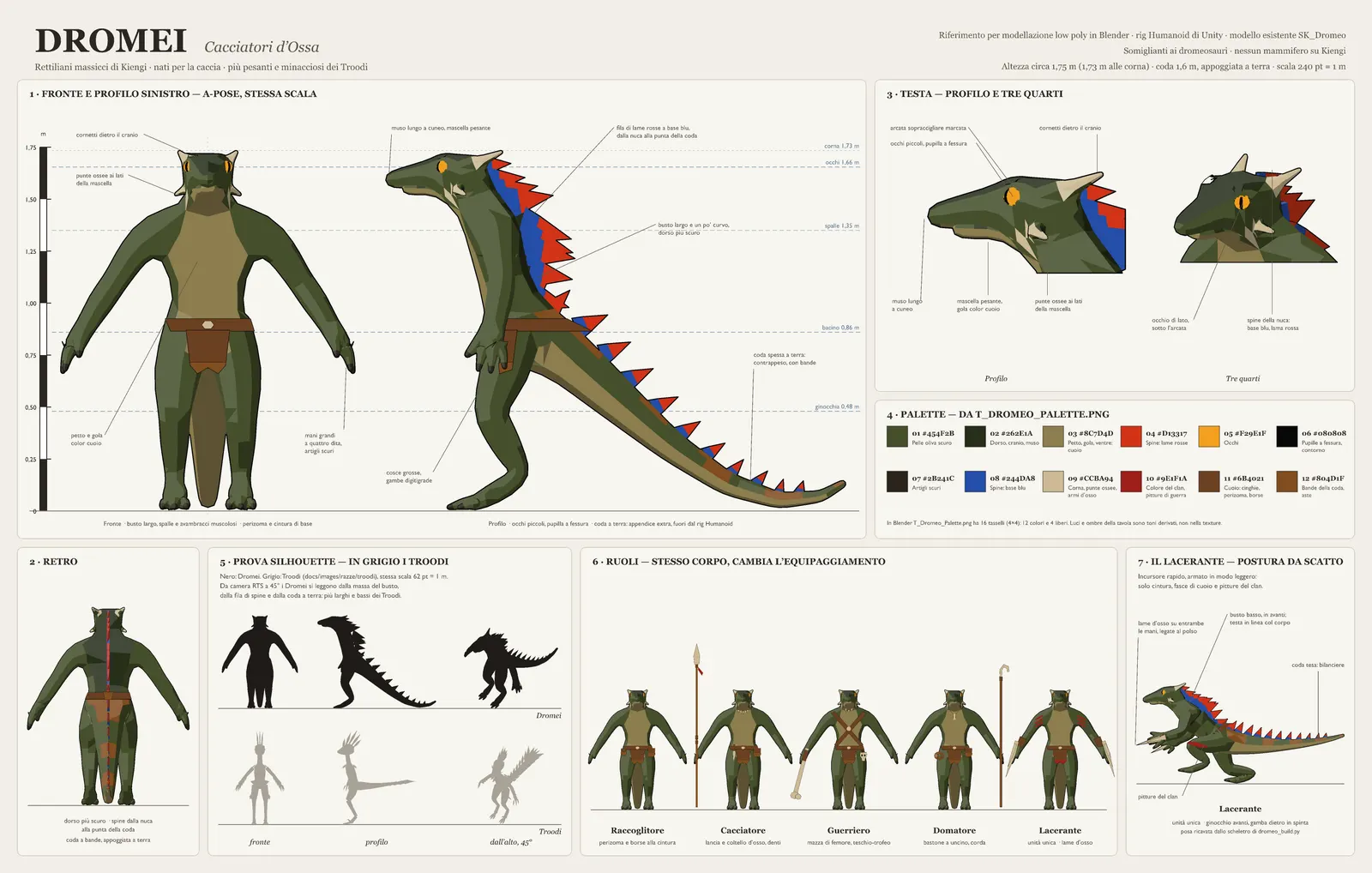 DromeiBone Hunters · Buranunu steppesPlayable
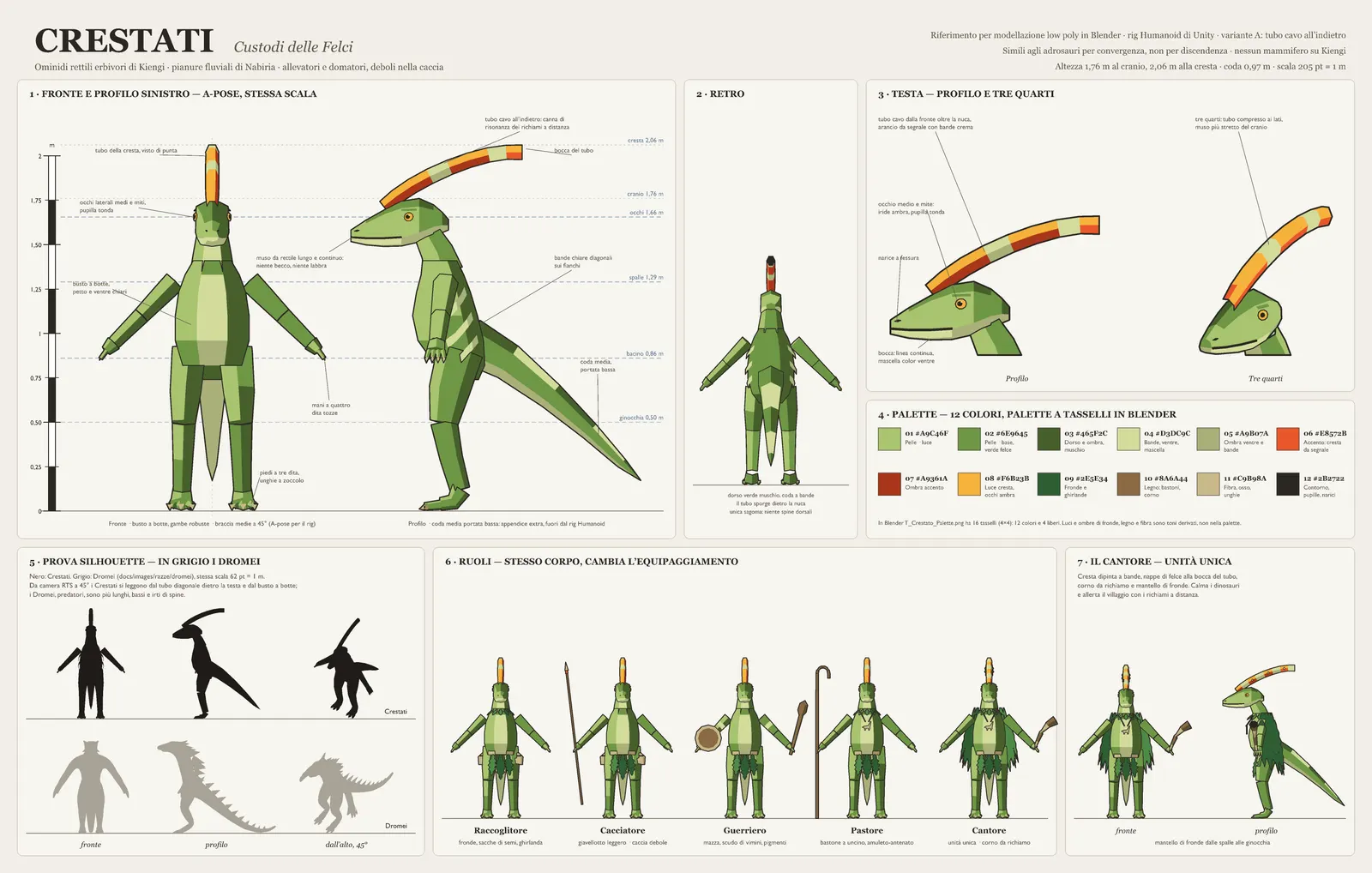 CrestatiFern Keepers · Nabiria plainsAfter the MVP
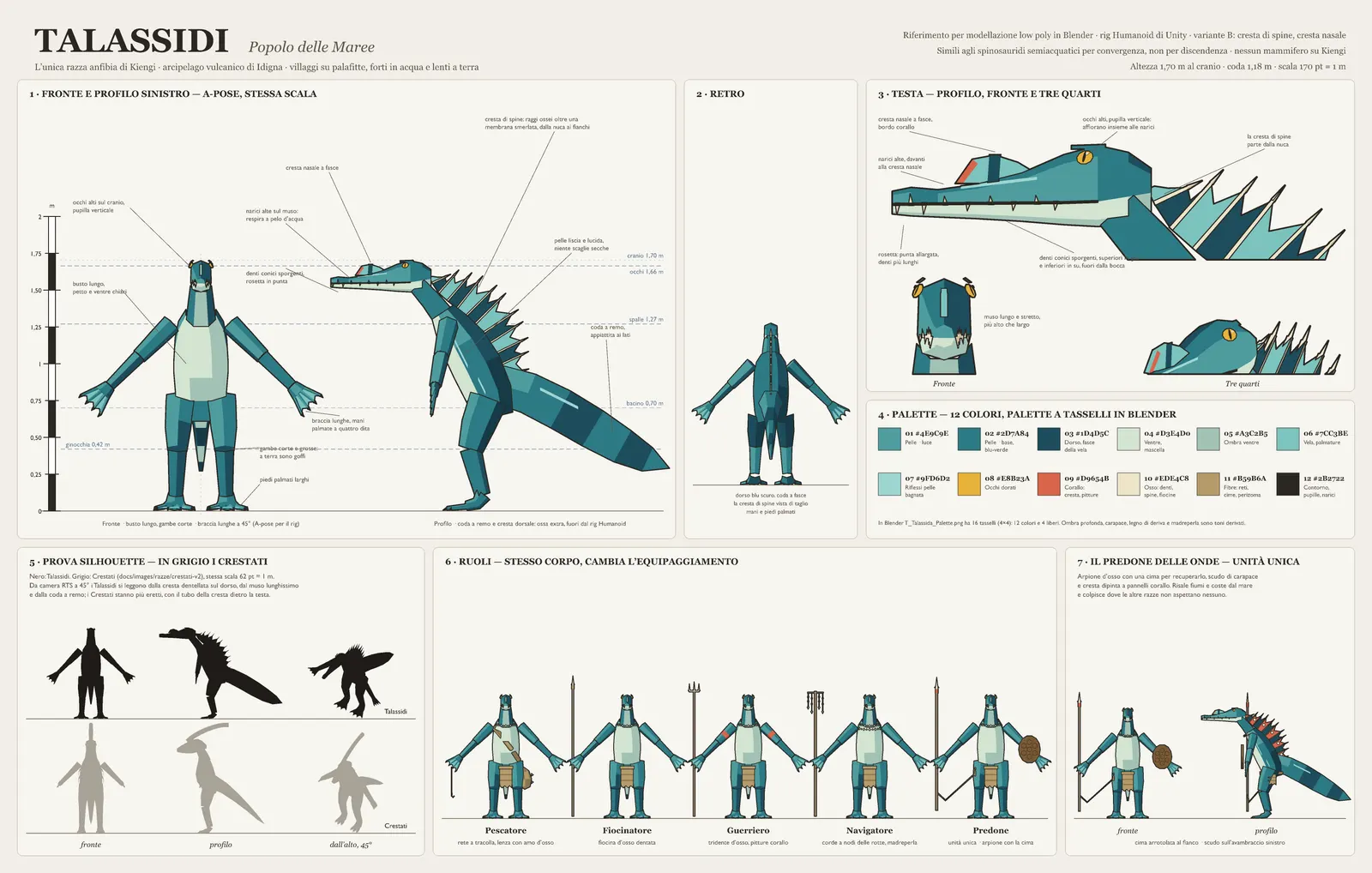 TalassidiTide People · lagoons of DilmunAfter the MVP
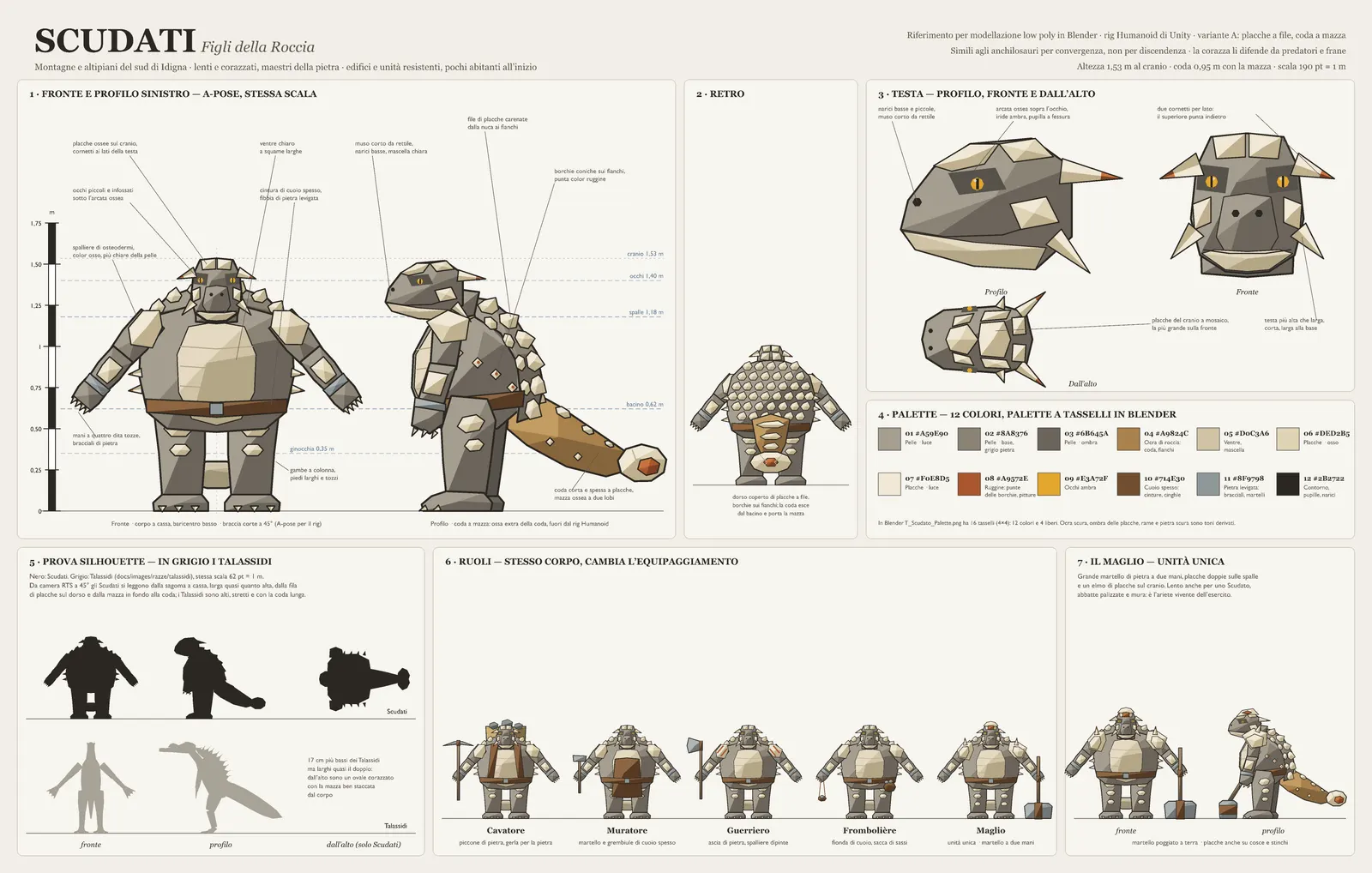 ScudatiChildren of the Rock · highlands of HursagAfter the MVP
Bonuses and weaknesses
| Race | Resembles | Bonus | Weakness | Unique unit |
|---|---|---|---|---|
| Troodi | troodontids | balanced, faster research, better resistance to cold | no military bonus | Fire Sage |
| Dromei | dromaeosaurs | hunting +30%, fast units, more bones from prey | slow herding, hunting raises Tension more | Ripper |
| Crestati | hadrosaurs | faster taming and herding, lower herbivore Tension | weak hunting, vulnerable to predators | Caller |
| Talassidi | semiaquatic spinosaurids | move and fight in water, fishing +50%, cross rivers | slow on land, suffer from drought | Wave Raider |
| Scudati | ankylosaurs | stone +30%, sturdier buildings and units | slow, small starting Population | Maul |
Roles by race
Each race gives the common Roles a name and equipment of its own, with the same mechanics.
| Role | Troodi | Dromei | Crestati | Talassidi | Scudati |
|---|---|---|---|---|---|
| Gatherer | Gatherer | Gatherer | Gatherer | Fisher | Quarrier |
| Scout | clan pennant on the back, signal horn, flask | the same, clear of the row of spines | icon only | icon only | icon only |
| Hunter | Hunter | Hunter | Hunter, light javelin | Harpooner | Slinger |
| Warrior | club with flints, clan shield | femur club, trophy skull | club, wicker shield | bone trident | stone axe |
| Archer | wooden bow, quiver on the back, tuft of clan feathers | recurved bow reinforced with horn, quiver at the hip | reed bow, quiver of woven fronds | horn bow, arrows with shell tips | short bow, leather quiver studded with bone |
| Breaker | wooden paddle club with obsidian blades, over the shoulder | femur head with obsidian blades, bone shoulder guards | tree-fern trunk with obsidian blades | jawbone with obsidian blades in place of teeth | stone club with obsidian blades |
| Sky Warrior | leaf-shaped iron blade, feather cape in the clan's color | curved iron blade, short leather cloak, bone pauldrons | iron blade | iron blade | iron blade |
| Tamer | staff, rope, whistle | hooked staff | Herder | to be drawn | to be drawn |
| Unique unit | Fire Sage | Ripper | Caller | Wave Raider | Maul |
Archer and Breaker, from M10, and the Sky Warrior, from M15, have sheets and models only for Troodi and Dromei, the playable races: the other three races keep the common name and the equipment in the table. The base weapons' tip is the race's own, flint for the Troodi and bone for the Dromei, and it turns black with Obsidian Weapons. The Talassidi Navigator and the Scudati Mason are future Roles, which arrive when the two Races become playable: the Navigator for the ships, the Mason for the Stone Walls.
Reproduction. Being reptiles, new hominids are born from eggs. In the game, production at the Camp is called Hatching: a production queue that costs food and time, around the bonfire that incubates the eggs.
The tribes
Each Race has a main Tribe, the one its Chapter follows in the Campaign, with a philosophy and a way of dealing with the other peoples. In the Skirmish the same philosophies guide the AI Tribes.
| Tribe | Race | Philosophy | With the other peoples |
|---|---|---|---|
| Flint Clan | Troodi | open the trade road, grow through technology | they trade with the Talassidi; their success draws the Dromei |
| Bone Hunters | Dromei | dominion: they hunt dinosaurs for trophies and power | the common antagonist: they subjugate or are driven back, and raise Tension even in the territories of others |
| Tide People | Talassidi | the sea is theirs: coastal and river folk, they live with the water | they defend their waters; they trade from their landings on the coast of Idigna |
| Fern Keepers | Crestati | they revere the great herbivores, they defend the forests | hostile to those who clear-cut, allies of those who respect the flora |
| Children of the Rock | Scudati | peaceful, keepers of the land and of the bones | neutral; they react if anyone touches their deposits, and they withstand sieges |
The peoples
Troodi
Flint Clan · small, slender and feathered
The most intelligent and least strong people, and the closest to the ancestor in body and mind: slender, with the large brain and enormous eyes inherited from life in the caves. They are the masters of fire, and the Flint Clan is the tribe of the first Mission of the Tutorial.
The main Tribe lives in the hill forests of northern Idigna, at the foot of the volcanoes and in the cool: hence the feathers and the resistance to cold. They want to open the trade road and grow through technology, with Caravans, Markets and Harbor, doing business with the Talassidi. Toward the dinosaurs they are observers: they study them without worshiping them, and understanding them makes them able to live alongside them and to tame them.
The myth
They keep the memory of the cave and of the fire, but believe they are the only ones born in the cave and the only true children of the fire. They say their fire has never gone out.
Appearance
- Body: about 1.5 m, 1.75 m with the crest. Narrow torso, long thin neck, slender arms with long three-fingered hands, long digitigrade legs with a raised sickle claw.
- Head: large for the body, short narrow snout, enormous amber eyes facing forward, a crest of red feathers from forehead to nape.
- Feathers: dark collar at the base of the neck, barred feathers on forearms and thighs, long raised tail with a fan of red feathers at the tip.
- Colors: ochre-brown, cream throat and belly, sand-gray legs, rust-red accent.
- Equipment: flint, tooth necklaces, leather bags and straps; hide cloaks when it is cold. The Fire Sage has longer, paler feathers and a staff with an ember.
At work
Gathering, chopping wood, digging stone, knapping flint, quarrying bones and building: six animations, each with its own tool. As the Flint Clan, the Troodi mount flint points and blades.
The Scout
The hominid who opens the fog of war carries nothing in hand: on the back is a pole with the clan pennant, which from the game camera sticks up above the crest, and at the hips a signal horn and a gourd flask.
Archer and Breaker
The Archer holds the simple wooden bow in the left hand and an arrow ready in the right, with the tuft of clan feathers and the leather quiver on the back. The Breaker carries over the shoulder a wooden paddle with a red lanyard and three obsidian blades per side, its head reaching next to the nape. With Obsidian Weapons the flint tips turn black, and with Shields the Warrior drops the small shield for a leather oval with a rope rim.
The Sky Warrior
The Sky Forge's unit holds in its right hand a leaf-shaped blade of hammered Sky Iron, low on guard, with a bone hilt wrapped in leather and a tuft of feathers on the pommel. On its shoulders it wears a feather cape with tips in the clan's color, which gives it its silhouette from the game camera. With the Shields it takes the big shield like the Warrior; with the Workshop's Weapons the blade does not change, because iron is already the hardest metal of Kiengi.
The peoples
Dromei
Bone Hunters · massive reptilians, born to hunt
A warlike people of pack hunters, who want dominion over the other Races. The main Tribe lives on the coasts and western steppes of Buranunu, in the arid belt, where it follows and hunts the migrating herds.
To them dinosaurs are prey. As a Tribe, the Bone Hunters are the common antagonist of the Campaign: they hunt for trophies and power, raise Tension even in the territories of others and carry their dominion by sea, on their ships, against the other peoples.
The myth
No true fragment: the Dromei have completely forgotten their common origin and believe they were born of the steppe and the hunt.
Appearance
- Body: about 1.75 m, broad, slightly hunched torso, muscular shoulders and forearms, large four-fingered hands with dark claws, digitigrade legs with thick thighs.
- Head: long wedge-shaped snout, heavy jaw, pronounced brow ridge, small eyes with slit pupils, small horns behind the skull and bony points at the sides of the jaw.
- Spines: a row of red blades with a blue base from the nape to the tip of the tail.
- Tail: thick, resting on the ground as a counterweight.
- Colors: dark olive with a darker back, leather-colored chest and throat, bands on the tail.
- Equipment: leather straps, belt pouches, bone knives and spears. The Warrior carries a femur club and a trophy skull.
At work
The same six jobs as the Troodi, with the poses adapted to the larger body: crouching, they keep the tail on the ground. As Bone Hunters, their tools have heads of bone and horn.
The Scout
Like the Troodi one, with the pennant pole clear of the row of spines and the bone horn at the hip.
Archer and Breaker
The Archer has the recurved bow reinforced with horn, with the red binding, and the quiver low on the hip; hunched, with the long snout, he draws with the bow tilted outward. The Breaker carries a femur head with condyles, bound with fiber and fitted with four obsidian blades per side, and spiked bone shoulder guards. With Obsidian Weapons the bone tips turn black; with Shields comes a hide shield on a cross-shaped bone frame.
The Sky Warrior
The Sky Iron blade is heavier and more curved than the Troodi one, with the edge swelling toward the tip and a horn hilt, held in the right hand and low on guard; instead of feathers, a short leather cloak with a hem in the clan's color, through which the back spines poke, and spiked bone pauldrons. With the Shields it takes the hide shield on a bone frame, and the blade stays iron even with the Workshop's Weapons.
The peoples
Crestati
Fern Keepers · calm herbivores with barrel chests
The main Tribe lives on Nabiria, in the fern forests of the river plains, beside the herds of the great herbivores. The crest is a hollow bony tube used to call to one another in the dense forests: a long, low note, like a horn.
They revere the great herbivores as ancestors and defend the forests: they are hostile to those who clear-cut and allies of those who respect the flora. They live in the territory of the cave of origins on the slopes of Kur, which to them is taboo, and do not understand its meaning.
The myth
They have always lived beside the herds of the great herbivores, and believe they descend from them.
Appearance
- Body: about 1.76 m at the skull and 2.06 m at the crest, barrel chest with a pale chest and belly, sturdy legs, stubby four-fingered hands, three-toed feet with hoof-like nails, tail carried low and without spines.
- Head: long, continuous reptile snout, without beak or lips, mild side-set eyes, amber with round pupils.
- Crest: a hollow bony tube from the forehead past the nape, signal orange with cream bands.
- Colors: fern green, moss-green back, pale diagonal bands on the flanks, banded tail.
- Equipment: woven fronds, seed pouches, garlands, pigments. The Caller has a crest painted in bands, fern tassels at the mouth of the tube, a signal horn and a cloak of fronds.
The peoples
Talassidi
Tide People · amphibious, strong in water and clumsy on land
The people who conquered the sea: evolution made them amphibious, and they live only on Dilmun, the volcanic archipelago of Idigna, and on the sea. They live alongside sea monsters like the mosasaurs and know how to tame the waters.
They live in stilt villages in sheltered lagoons and have trading landings on the coast of Idigna. They are the only ones who know the routes between the continents, and to them the Land of the Giants is a legend glimpsed along the routes of the sea reptiles.
The myth
They remember the rising sea, but believe they came from the sea, carried by the sea reptiles.
Appearance
- Body: about 1.70 m at the skull, long torso, short thick legs, long arms with webbed four-fingered hands, broad webbed feet, paddle tail flattened at the sides.
- Head: very long, narrow snout with the tip widened into a rosette and protruding conical teeth; nostrils set high before a nasal crest edged with coral, for breathing at the water's surface; high-set eyes, golden with vertical pupils.
- Spine crest: bony rays over a scalloped membrane, from the nape to the flanks.
- Skin: smooth and glossy, blue-green with a dark blue back, pale belly and coral accents.
- Equipment: nets, bone hooks and harpoons, necklaces of shells and mother-of-pearl. The Wave Raider has a harpoon with a line to retrieve it and a carapace shield.
The peoples
Scudati
Children of the Rock · low and broad as a crate
A peaceful people, keepers of the land and of the bones. The main Tribe lives on the highlands of Hursag, in southern Idigna, cool because of the altitude: the armor protects them from predators and landslides, and from those who besiege them.
The bone piles are ancient dinosaur graveyards laid bare by the erosion of the highlands: deposits of bones and sacred places at once. The Scudati respect living dinosaurs and revere their bones. As a Tribe they are neutral, but they react if anyone touches their deposits, and the dominion of the Dromei breaks against their defenses.
The myth
They remember the great eruption and the death of the world: in the bone piles they see the dead of that end and they guard them.
Appearance
- Body: about 1.53 m at the skull, almost as wide as tall, low center of gravity, short arms, column-like legs and broad feet.
- Armor: bone-colored osteoderm shoulder pads, rows of keeled plates from the nape to the flanks, conical studs with rust-colored tips.
- Head: mosaic skull plates, two small horns per side, small eyes sunk under the bony brow.
- Tail: short and thick, covered in plates, with a two-lobed bony club.
- Colors: stone gray, rock ochre on tail and flanks, bone-colored plates, rust accents.
- Equipment: leather belts with polished stone buckles, stone bracelets, picks, hammers and baskets. The Maul has a two-handed stone hammer and a helmet of plates: it is the living battering ram of the army.
The fauna
The dinosaurs of Kiengi
A third force, neither friend nor foe
The species start from Earth ones, but on Kiengi they evolved their own forms: the Earth name tells you the group and the role in the game, not the look. Every species has at least one Kiengi trait that its Earth relative lacks and that you can read even from afar.
The style follows the iconic silhouettes of Jurassic Park and Jurassic World Evolution, with a few feathers on the theropods. Every body plan (theropod, ornithopod, quadruped and, with M9, sauropod and flyer) has a common rig and set of animations, and every species is a variant generated by script.
Temperaments
Like the wild animals of Age of Empires, every species has a fixed temperament.
- Prey flees and is hunted for food, like the deer.
- Defensive grazes, charges whoever attacks or disturbs it, and is hunted in a group, like the boar or the elephant.
- Predator attacks any hominid that enters its range, like the wolf or the crocodile. By day it also attacks the lone hominid it sees: outside the Light, with no companions of its tribe within 10 m and more than 40 m from its buildings.
- Thief the temperament of the flyers, with M9: it hurts no one but by day it steals food and carries it to the Roost, their nest. It dives on the loaded Gatherer and takes a part of the load (4, 8 for the Pteranodon), or lands next to a Carcass or a Field, if the tribe does not have the Bogeyman; then it rests a minute and a half, and from a flock it steals one animal at a time per tribe. Above 70 tension it also steals from the stores, at the food depots that no Tower covers. In a dive only Hunters and Towers hit it, when landed everyone does. Tension is raised by hunting and by disturbing the Roost, not by the theft.
The herds are finite and regenerate slowly: hunting too much exhausts the food for everyone. Everything can be brought down, even the Tyrannosaurus, though it takes a small army. Above the temperaments there is tension.
The eight species of the MVP
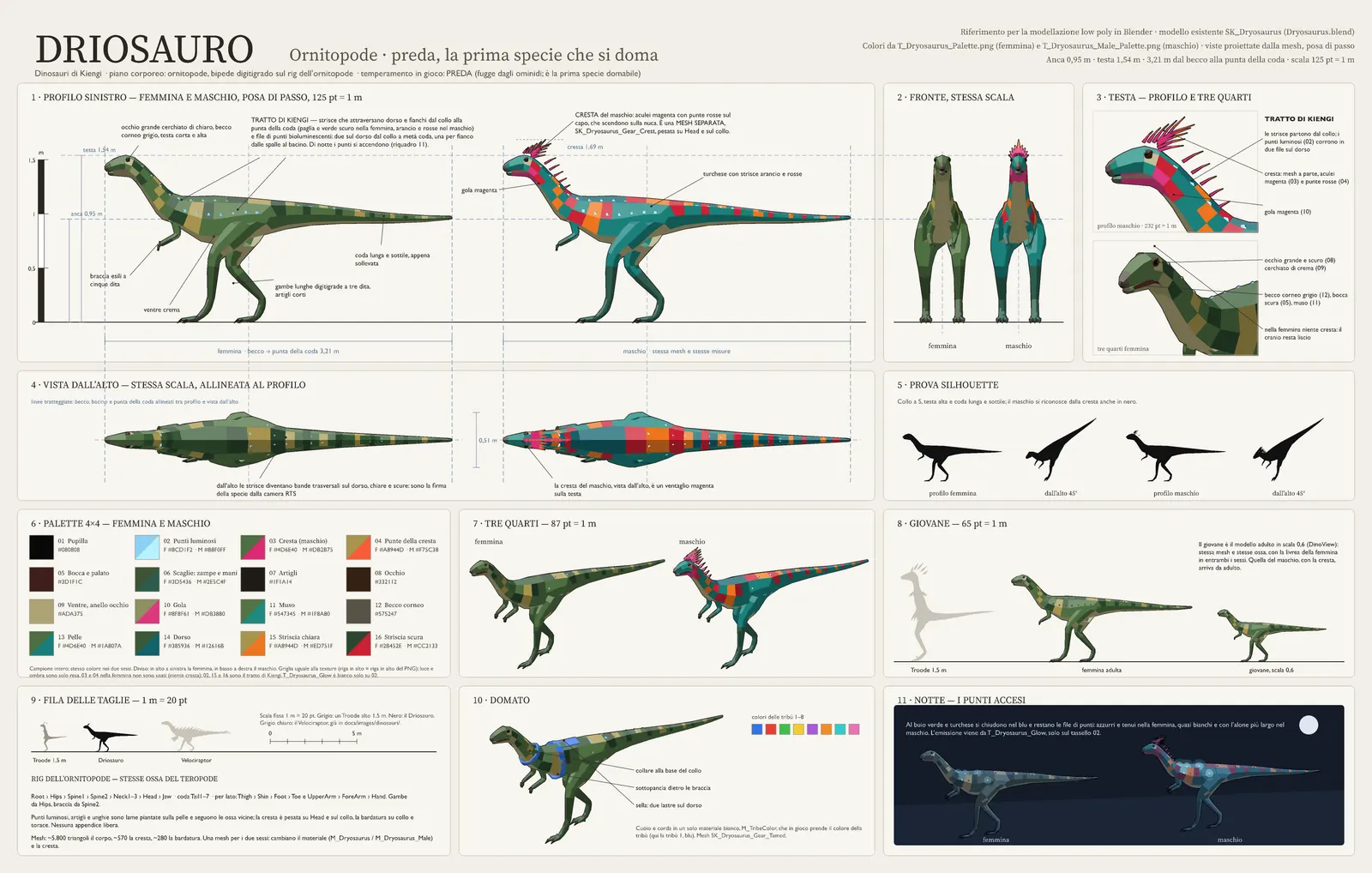 Dryosaurusornithopod · the first tameable speciesPrey
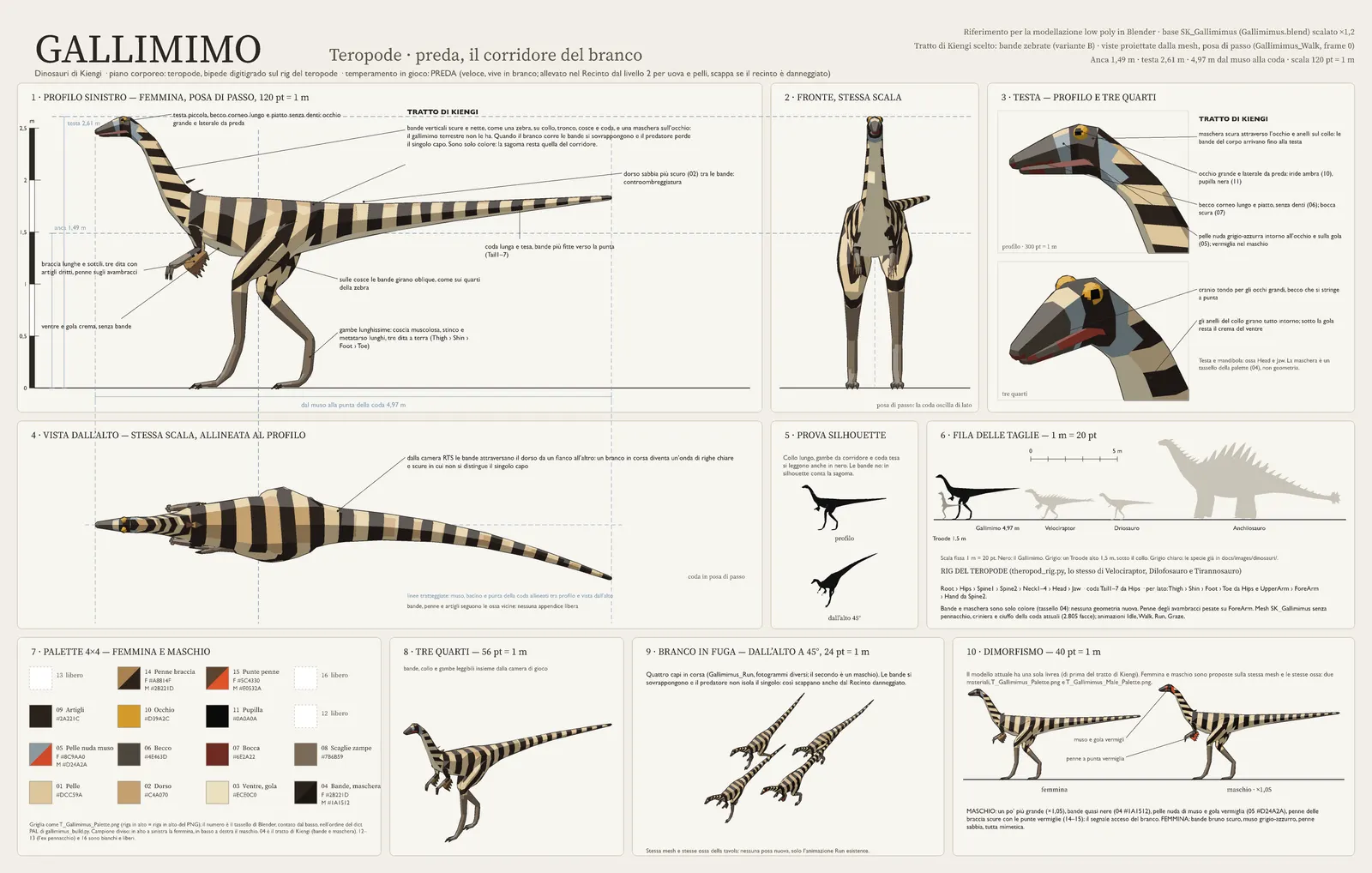 Gallimimustheropod · the runner of the faunaPrey
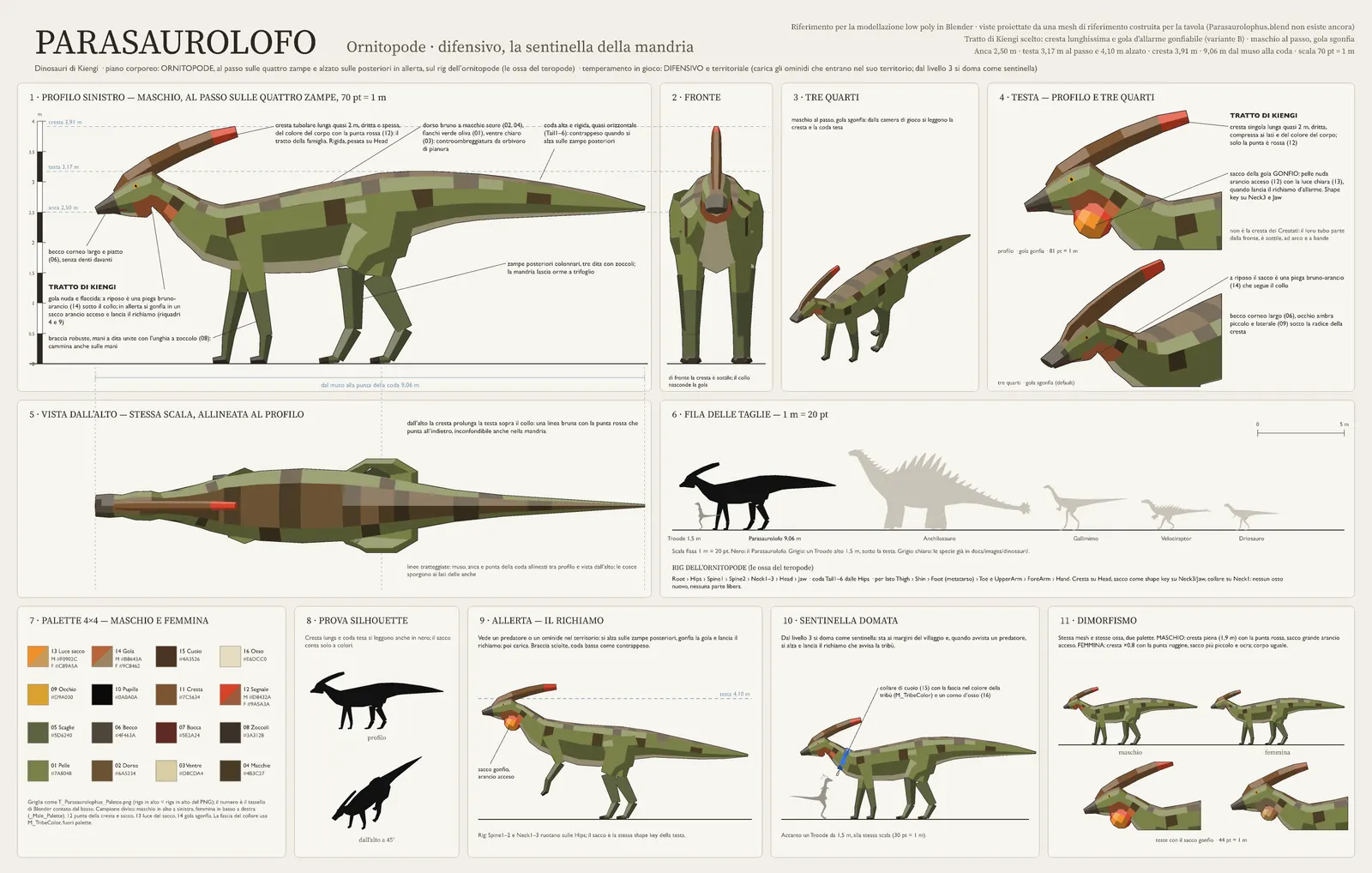 Parasaurolophusornithopod · territorial, future sentinelDefensive
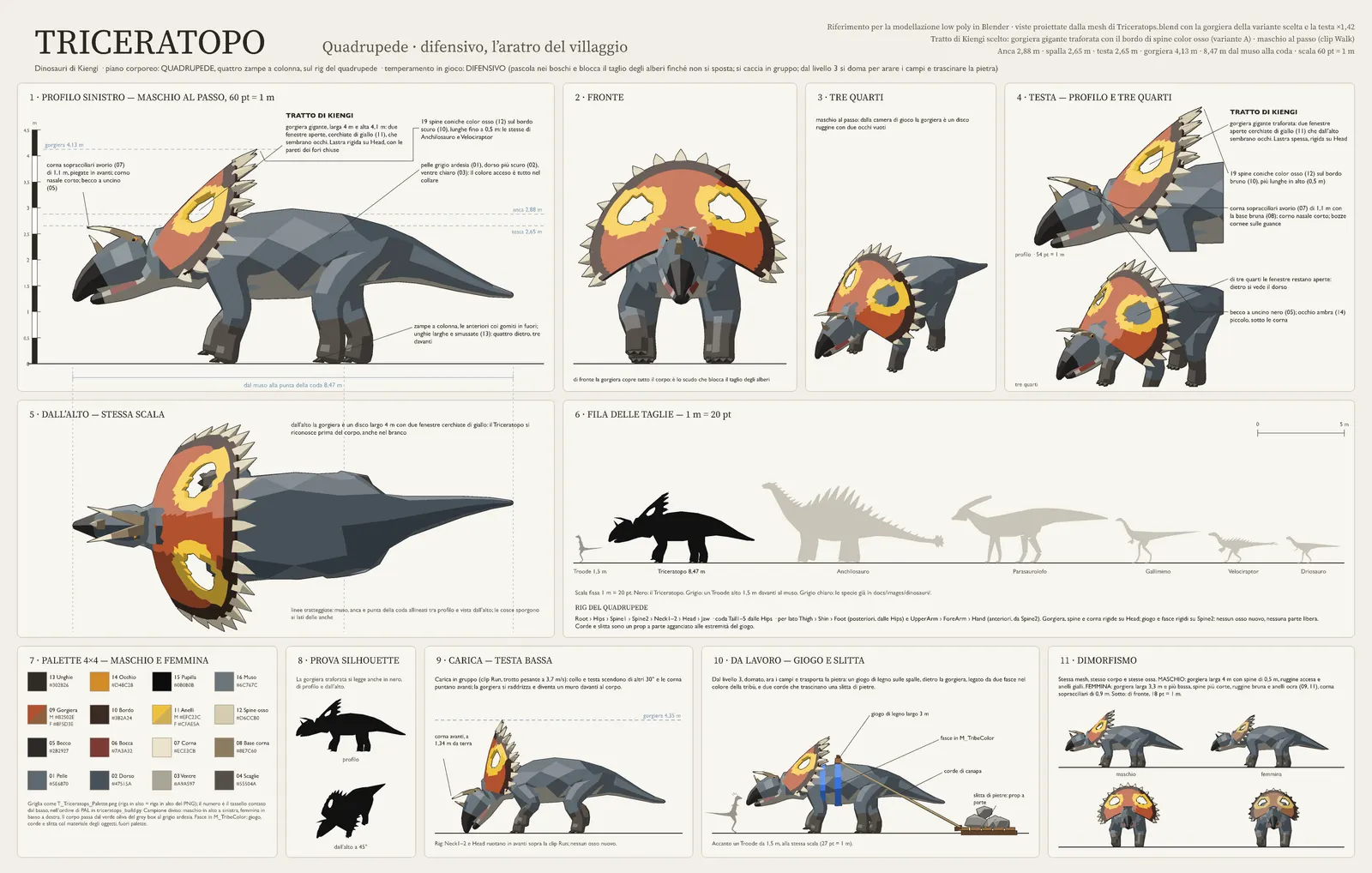 Triceratopsquadruped · for work and caravansDefensive
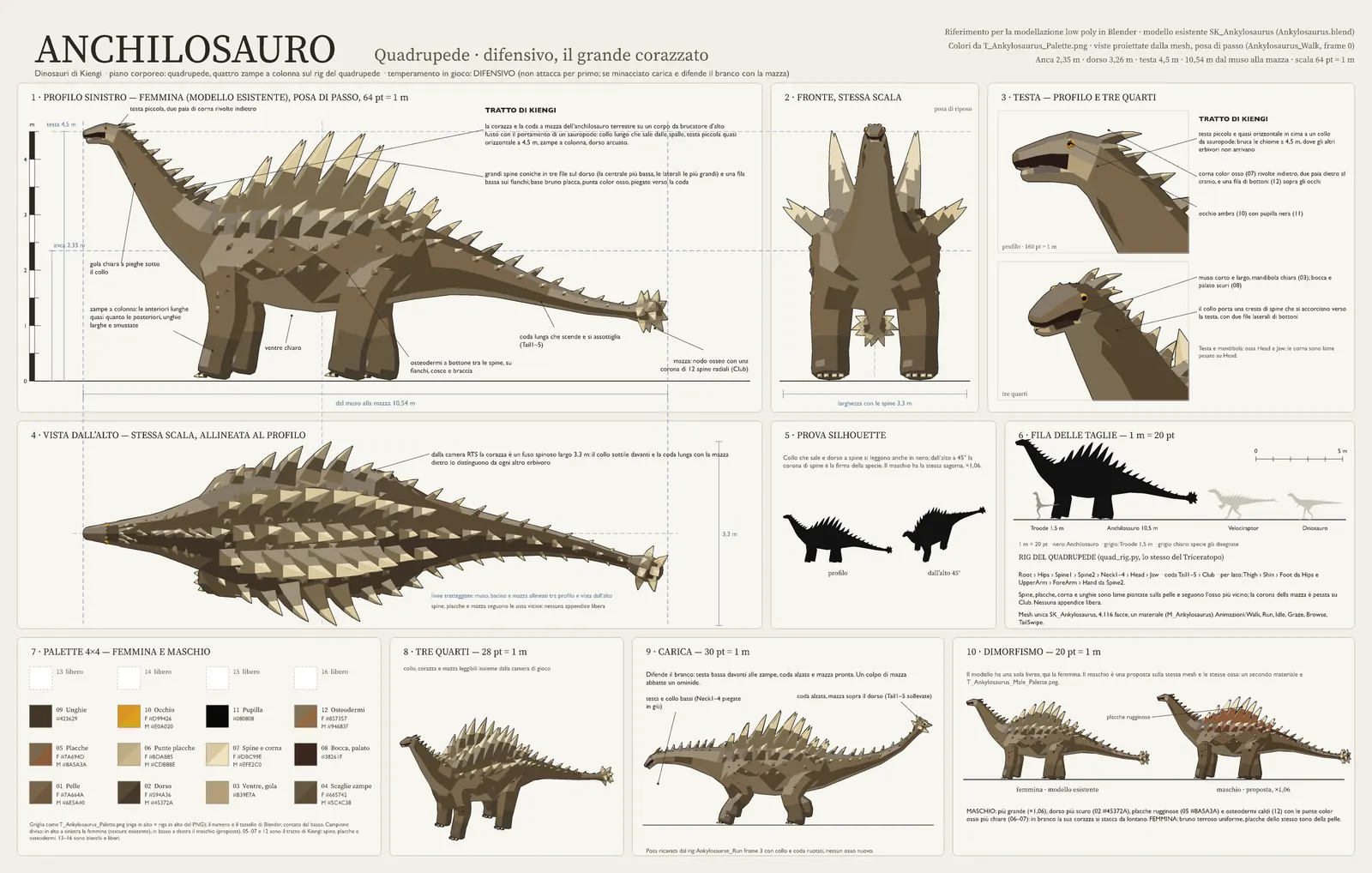 Ankylosaurusquadruped · the riskiest huntDefensive
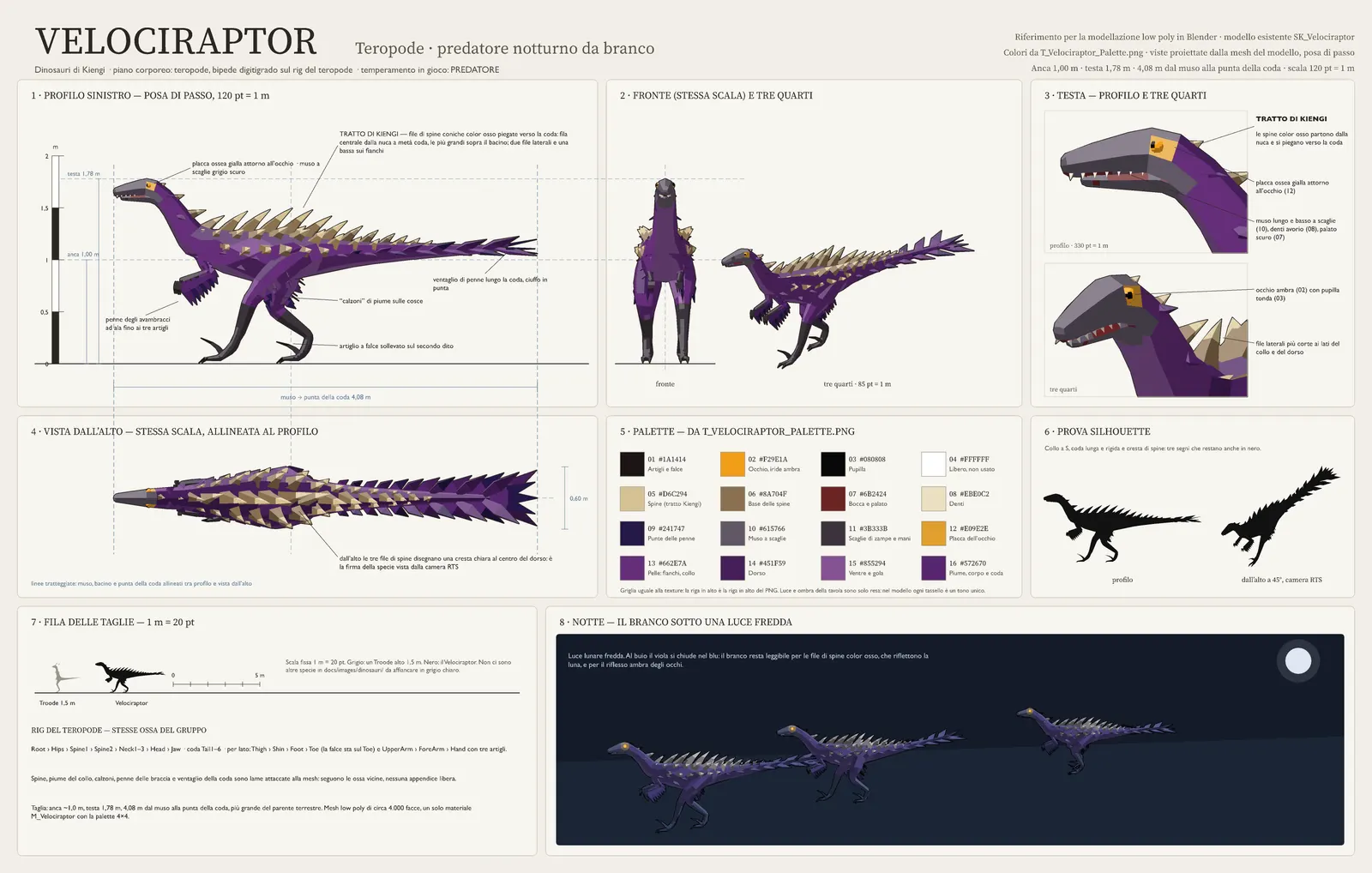 Velociraptortheropod · the pack of the nightPredator
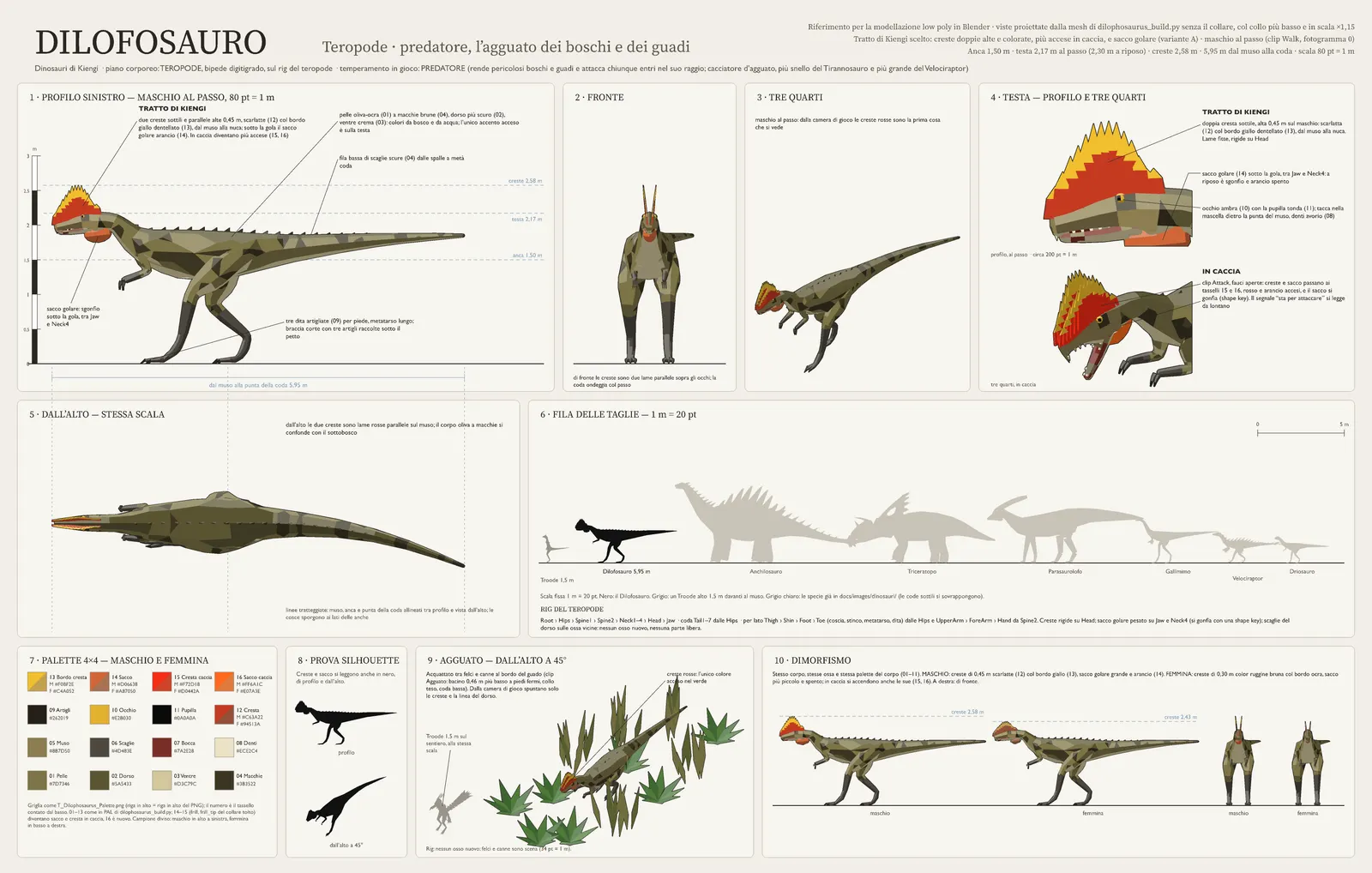 Dilophosaurustheropod · the ambush of woods and fordsPredator
Tyrannosaurustheropod · the apex predatorPredator
Food chain
Predators eat prey: Velociraptor and Dilophosaurus hunt Dryosaurus and Gallimimus, the male Tyrannosaurus the big herbivores, and the prey they kill leave Carcasses that the tribes can gather. Carcasses give a lot of food but draw the carnivores: 30 seconds after the prey dies, the nearest carnivore pack within 80 m that has not yet eaten in the cycle goes there, makes it its meal and bites whoever butchers it. As soon as one animal goes into Retreat the pack leaves it, so a guarded Carcass stays with the tribe. Adult sauropods are no one's prey: predators hunt only their young.
Wiping out a species alters the chain: its predators go hungry and fall back on the hominids, its prey grow beyond the territory, and the tribe that kills the last animal takes tension from all the species tied to that one.
The water predators
With M12 the first shore predators arrive, as grey boxes (colored capsules) until they have sheets and models. Their territory is a stretch of shore: they move on the land at the water's edge, graze and are born there, and bite whoever fishes or works in the territory, which shows up in the alerts of the nearby nodes. They can be hunted and leave a Carcass, they have tension like the raptors, and they cannot be tamed.
- Sarcosuchus: the ambush on the shore. It does not hunt: it waits. 250 Health, a 15 bite, 6 m perception.
- Spinosaurus: it prefers the water but also hunts on land, Dryosaurus and Gallimimus by day; rarer and bigger, 600 Health, a 22 bite, 12 m perception.
They live along the river of the Northern Hills of Idigna, with a Fish Shoal in the territory, and on the shores of the Valley lake.
The fauna of Arali
Arali is the fragment of the pangea that broke off first and the farthest from Kur: the great eruption barely touched it. Its species are the world from before, survived only there. On Kiengi there are no distinct periods like the Jurassic and the Cretaceous of Earth: that these species resemble Jurassic ones and the rest of the fauna Cretaceous ones is only a coincidence of working names. The Brontosaurus is the exception: it migrates constantly and also lives in the other lands. Only the Gliders know them, so they start with no tension toward the other tribes. In the game they live in the Mašu Island region of the generated Skirmish (M9): an island split into two sides by the Mašu range, with the first sauropods and the first flyer.
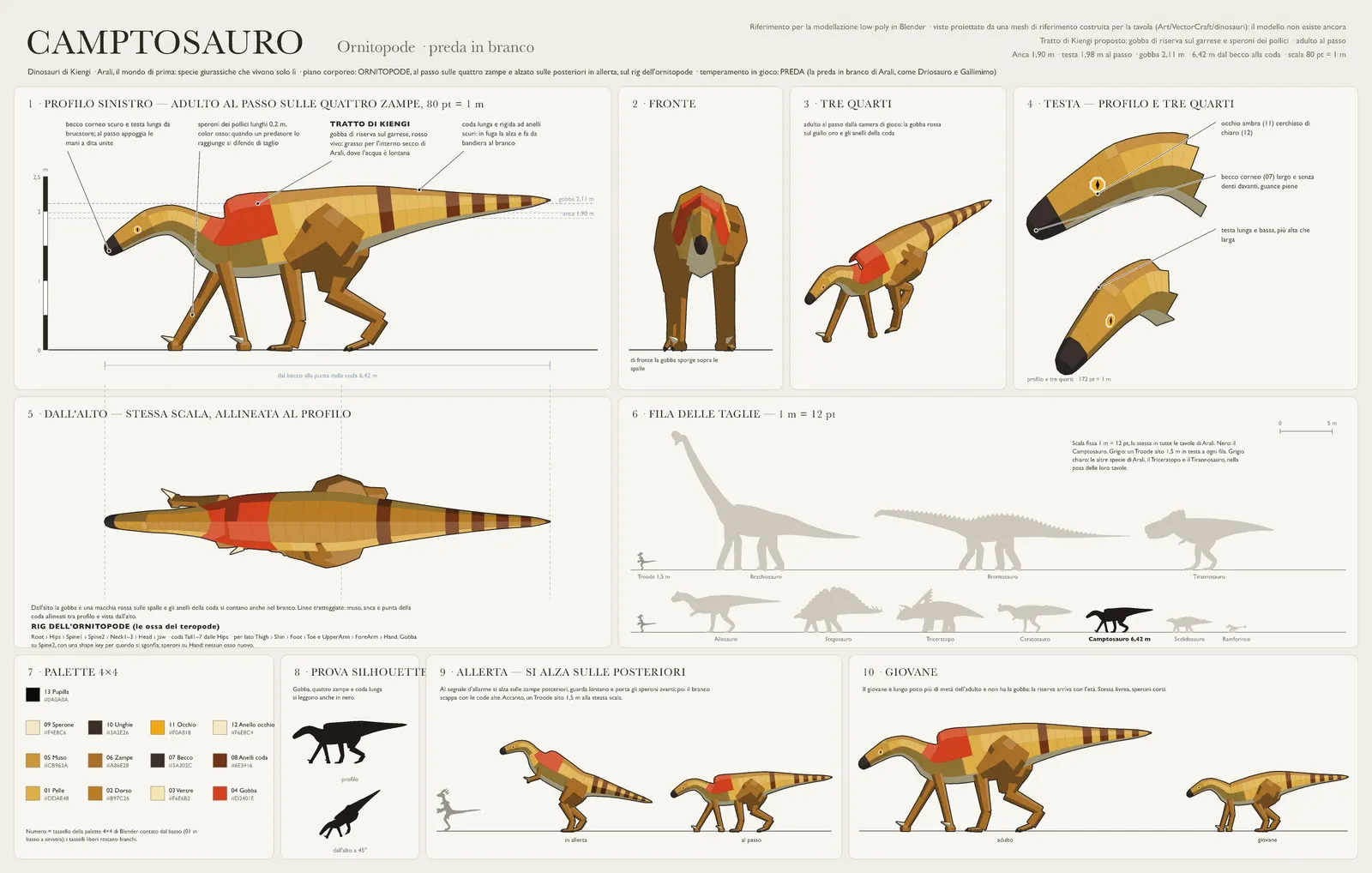 Camptosaurusornithopod · the herd prey of AraliPrey
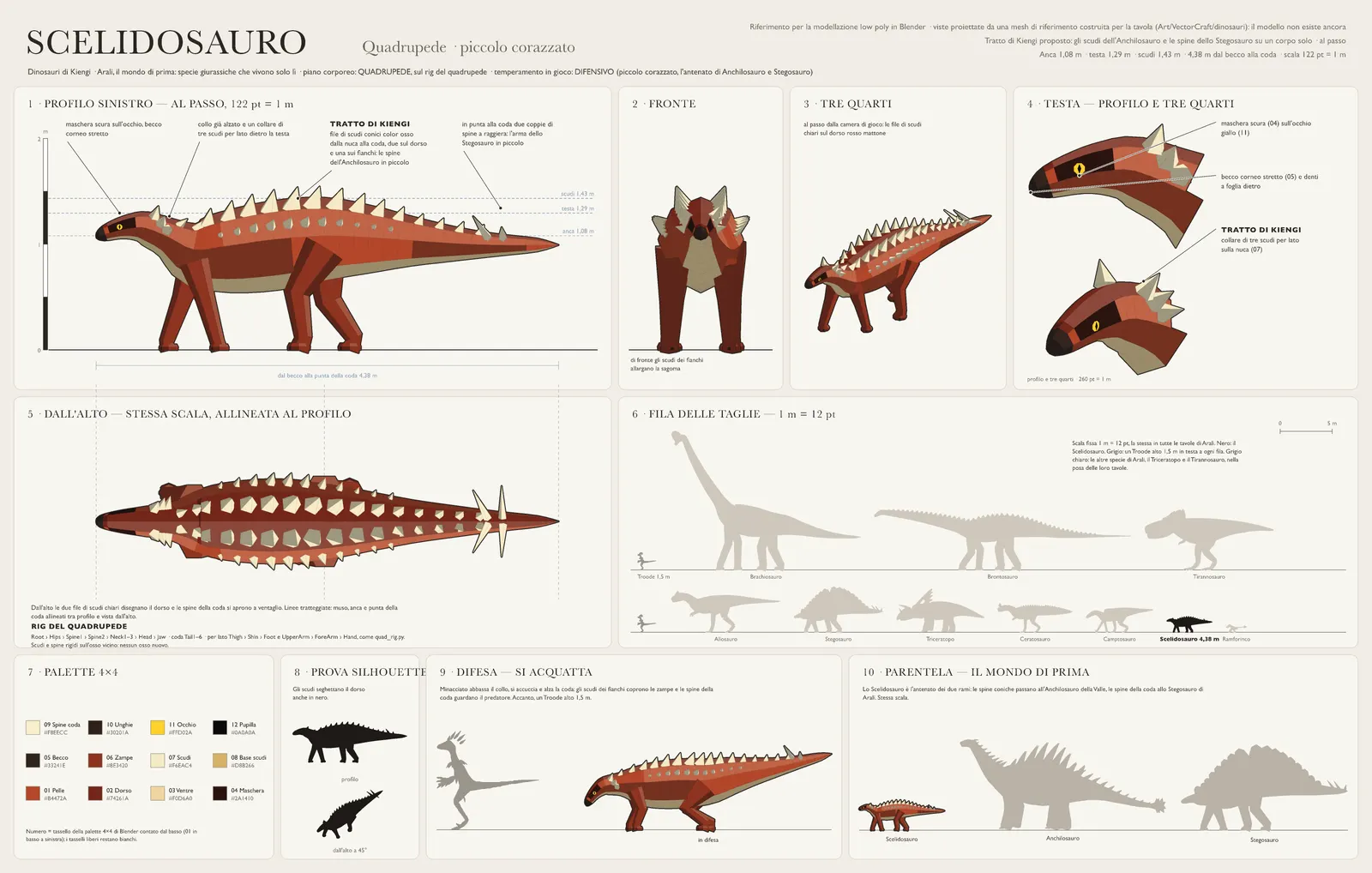 Scelidosaurusquadruped · the ancestor of the armored onesDefensive
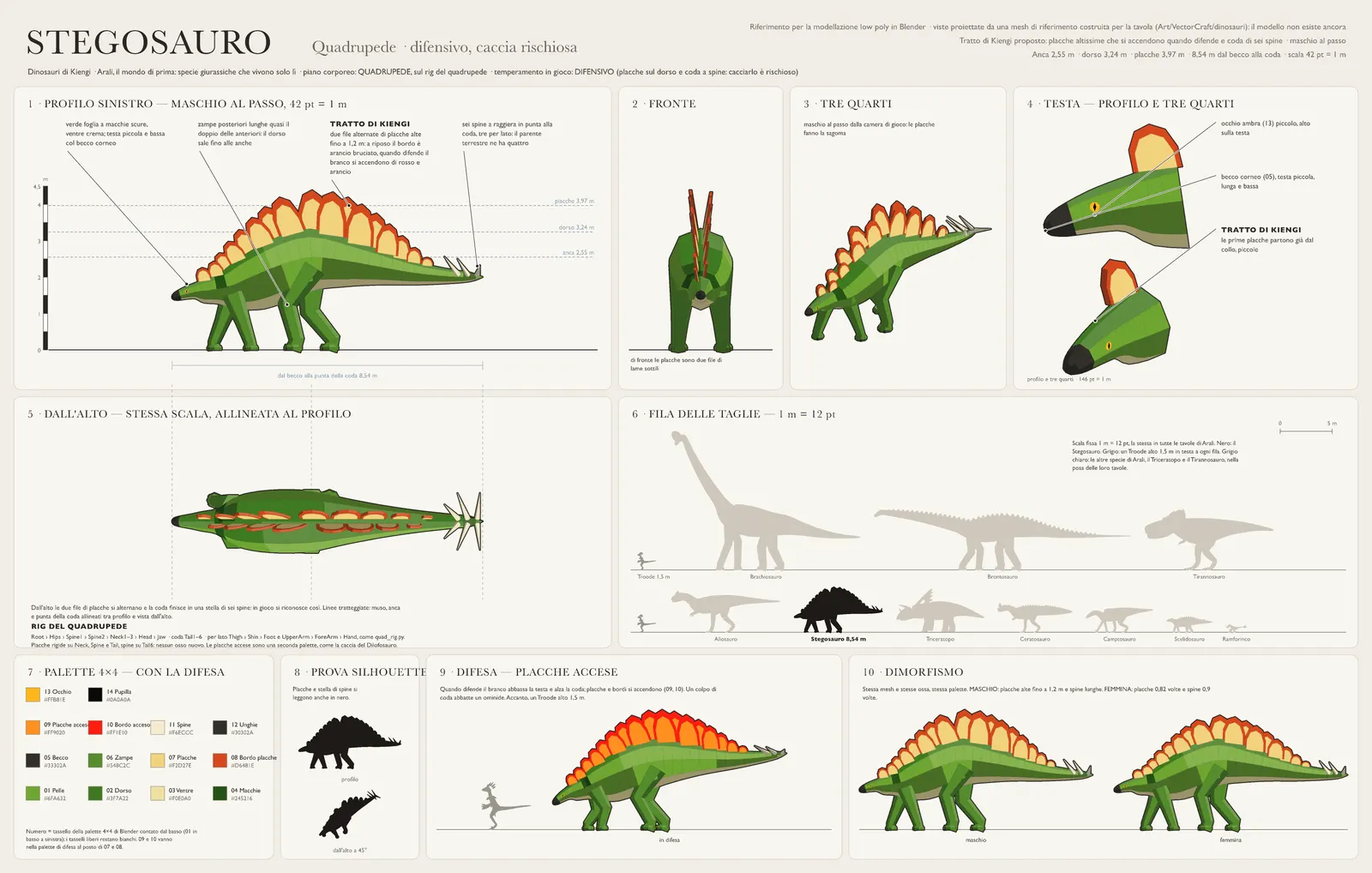 Stegosaurusquadruped · plates and a spiked tailDefensive
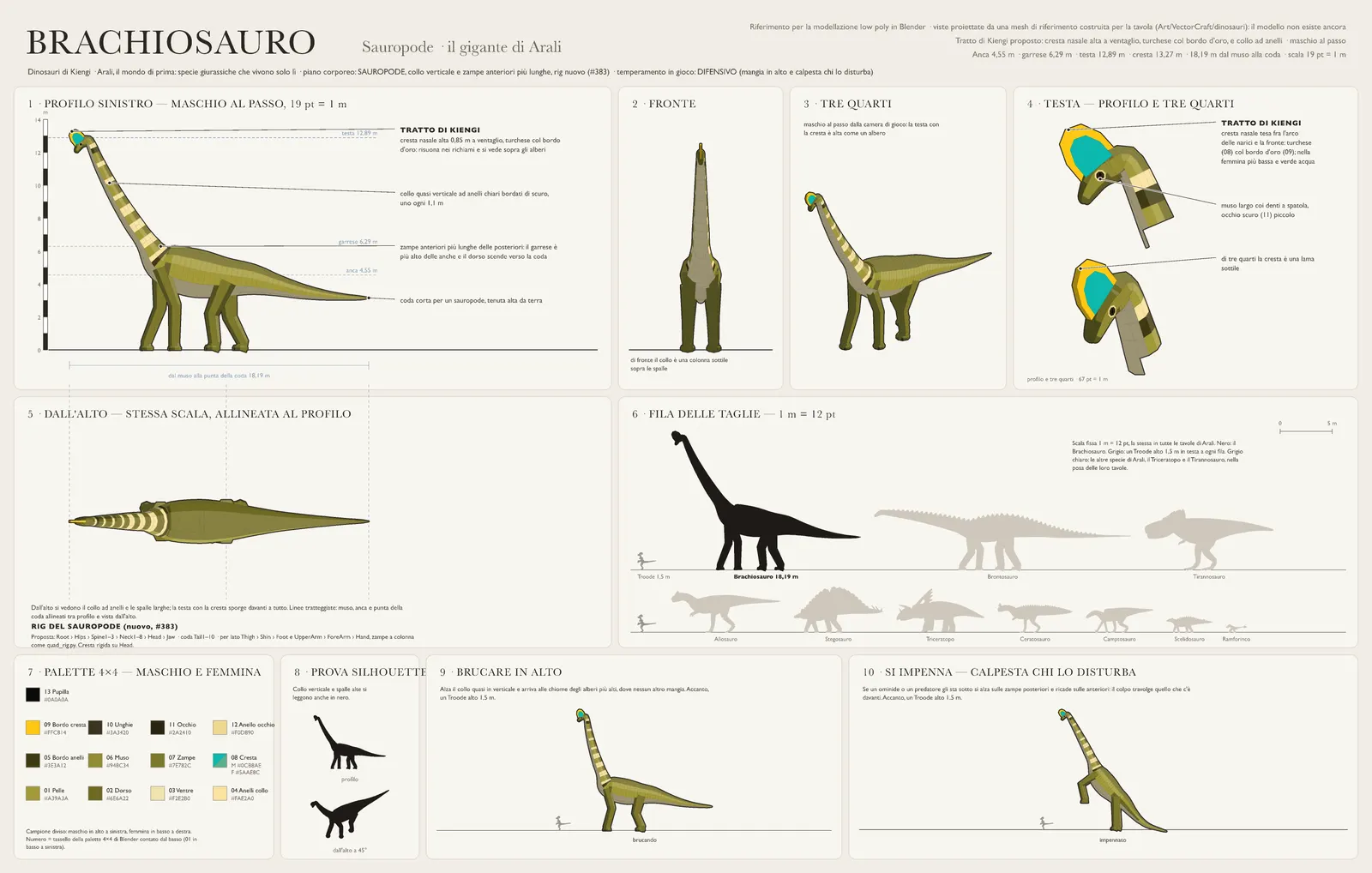 Brachiosaurussauropod · the giant of AraliDefensive
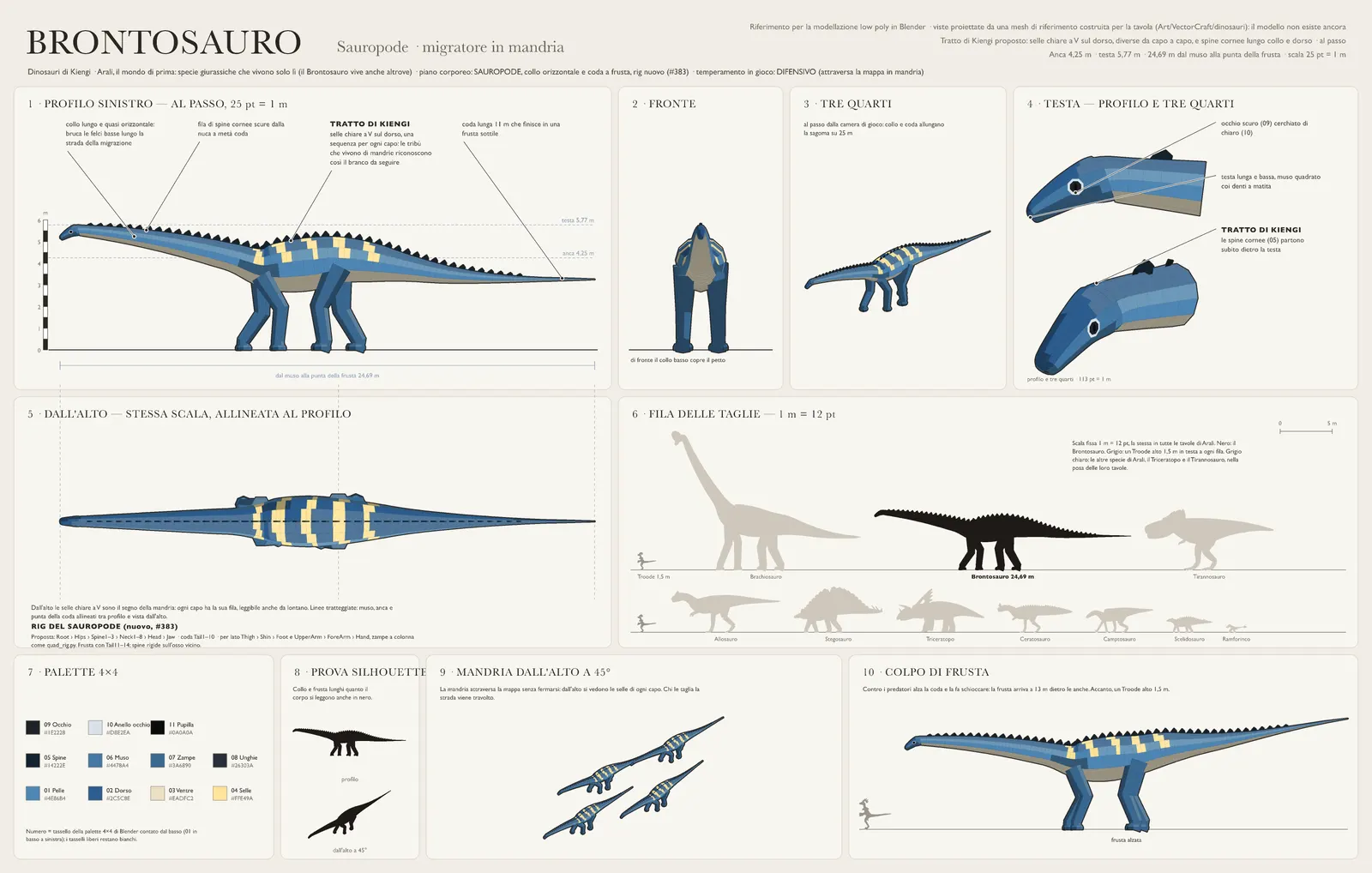 Brontosaurussauropod · the great migrantDefensive
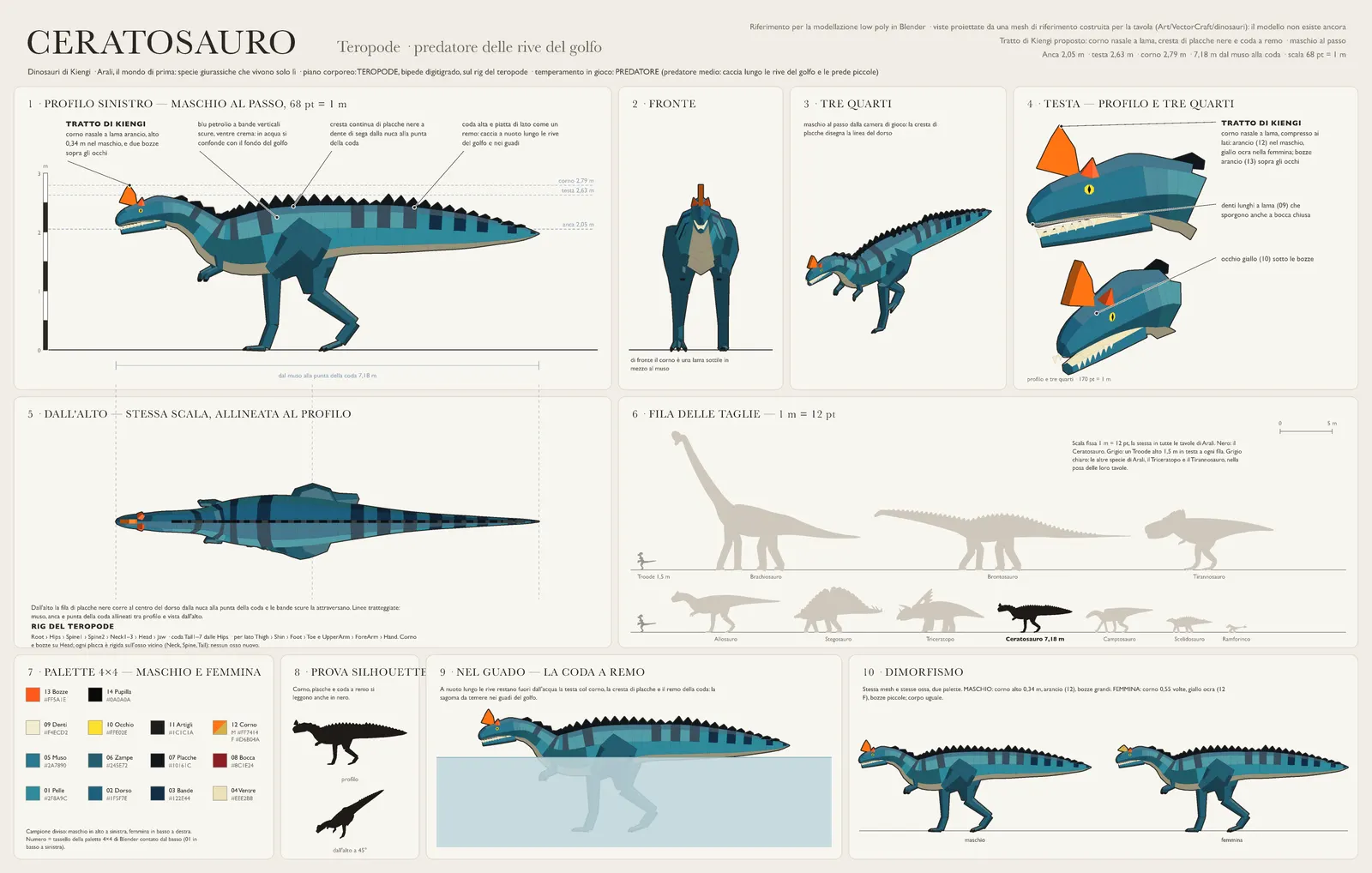 Ceratosaurustheropod · the hunter of the shoresPredator
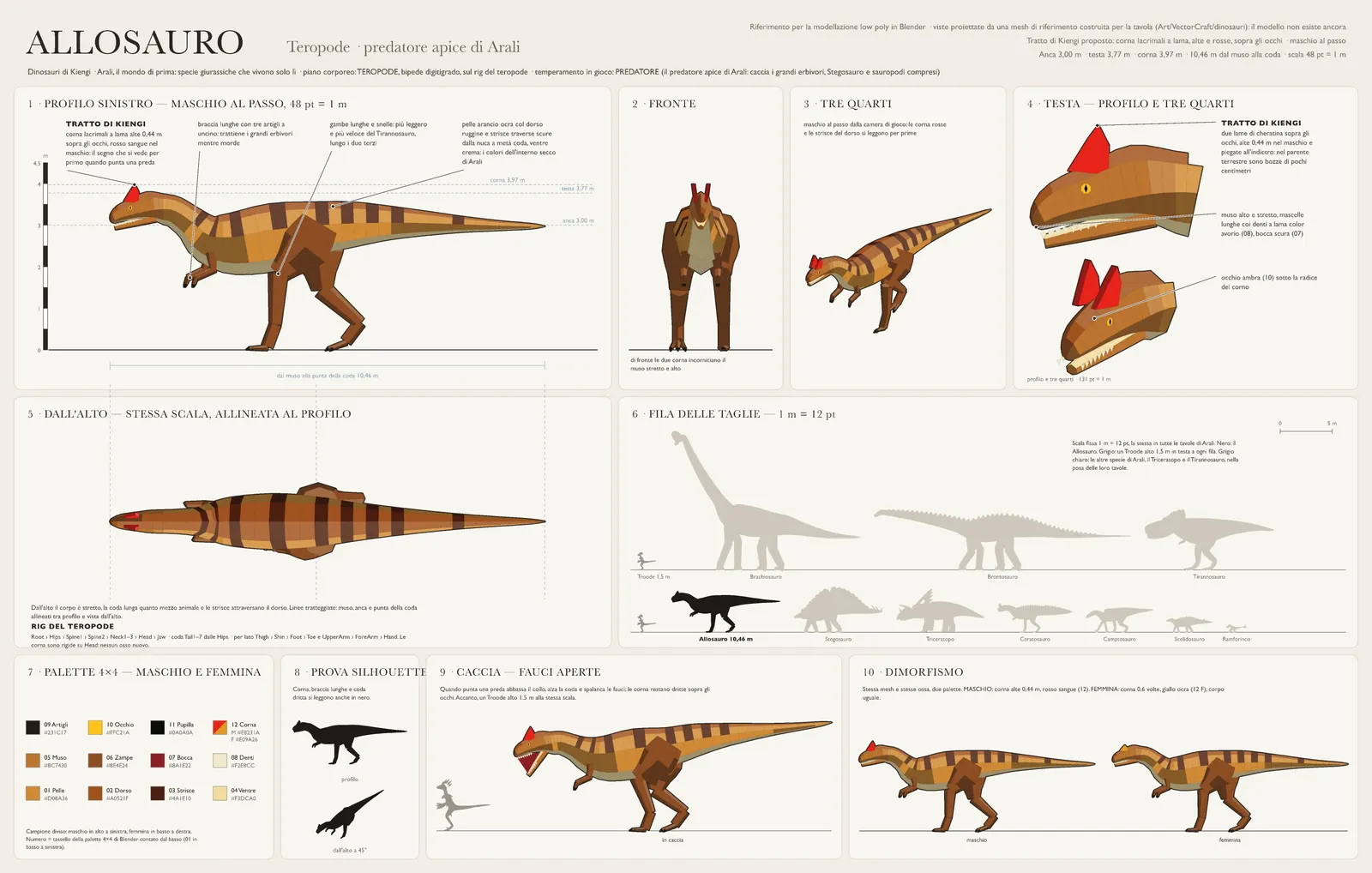 Allosaurustheropod · the apex predator of AraliPredator
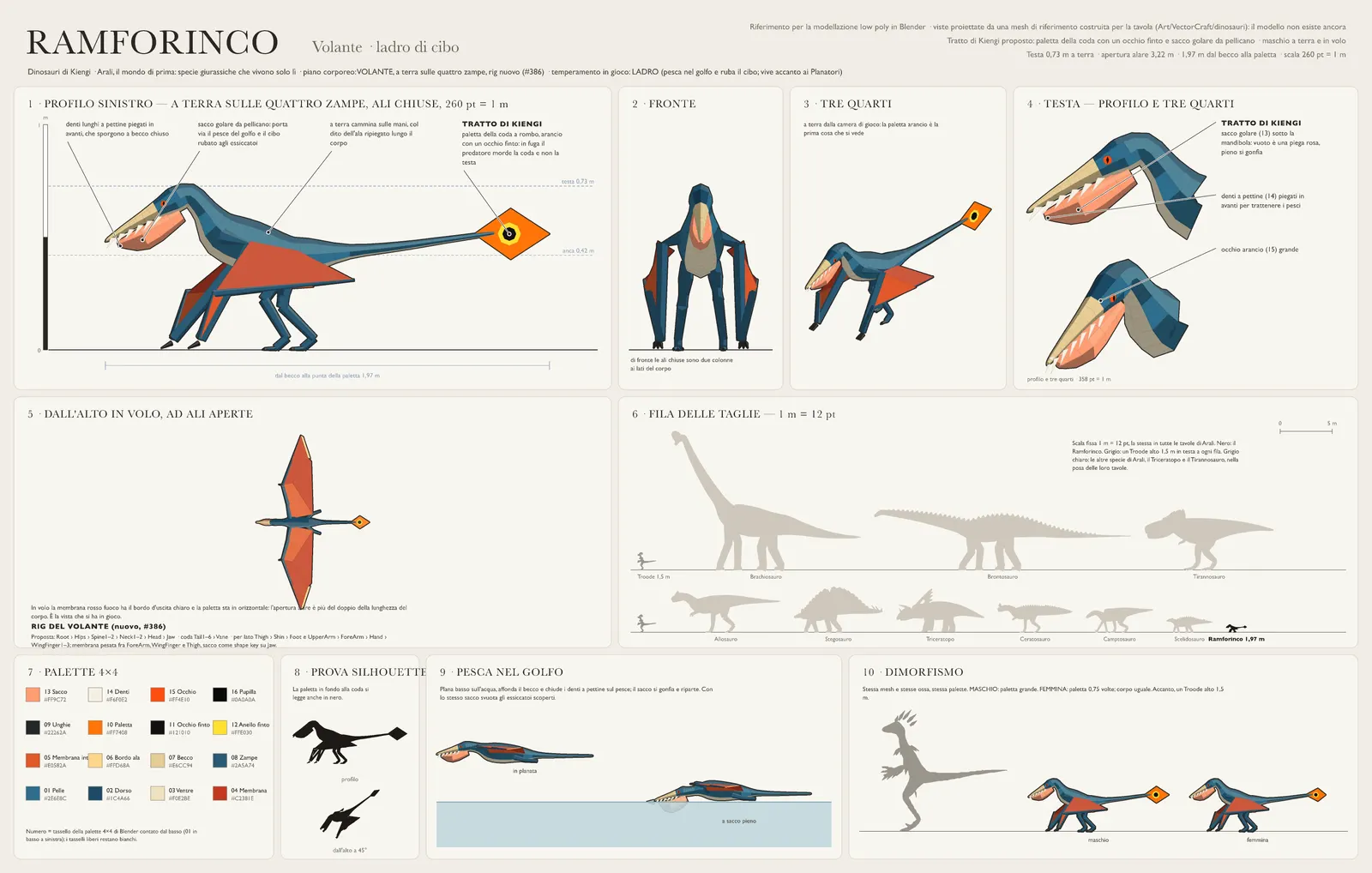 Rhamphorhynchusflyer · the thief of the gulfThief
The sheets of the Arali species are generated by Art/VectorCraft/dinosauri/genera.py and all have the same size row, at 1 m = 12 pt, with the Triceratops and the Tyrannosaurus. With M9 all eight are in Unity, with model, clips and icon, and they play in Mašu Island; the Brontosaurus also migrates in the Buranunu Steppes.
The flyers of all the maps
Outside Arali the Thieves are the Pteranodon, big and slow, and the Tapejara, small and fast: every base on the generated maps and on the Valley has a Roost of each nearby. Rhamphorhynchus, Pteranodon and Tapejara are tamed in the Aviary. Above woods and bushes fly the flocks of Anurognathus, the first ambient fauna: only to look at, with no Health or tension.
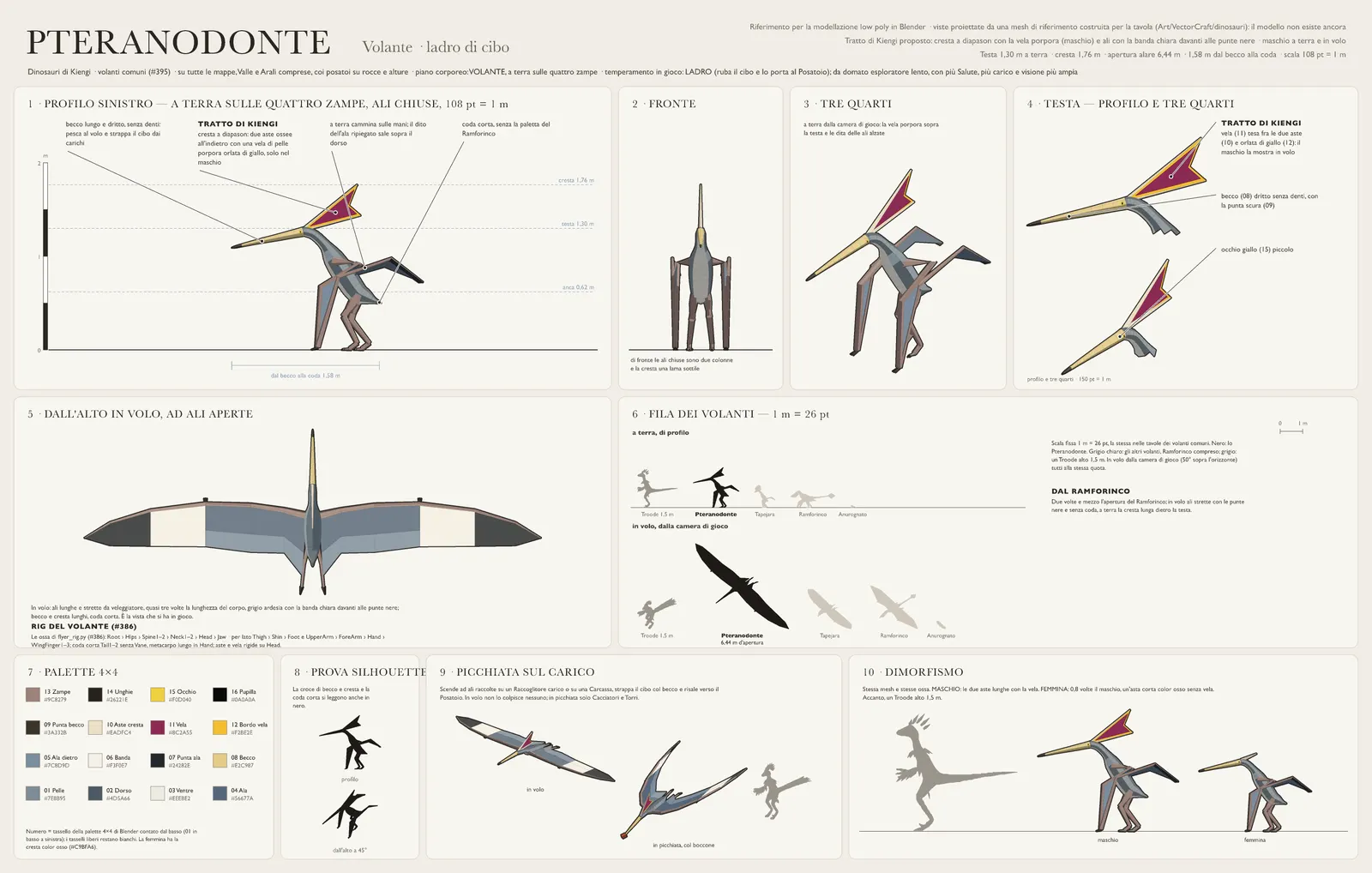 Pteranodonflyer · the glider with the tuning-fork crestThief
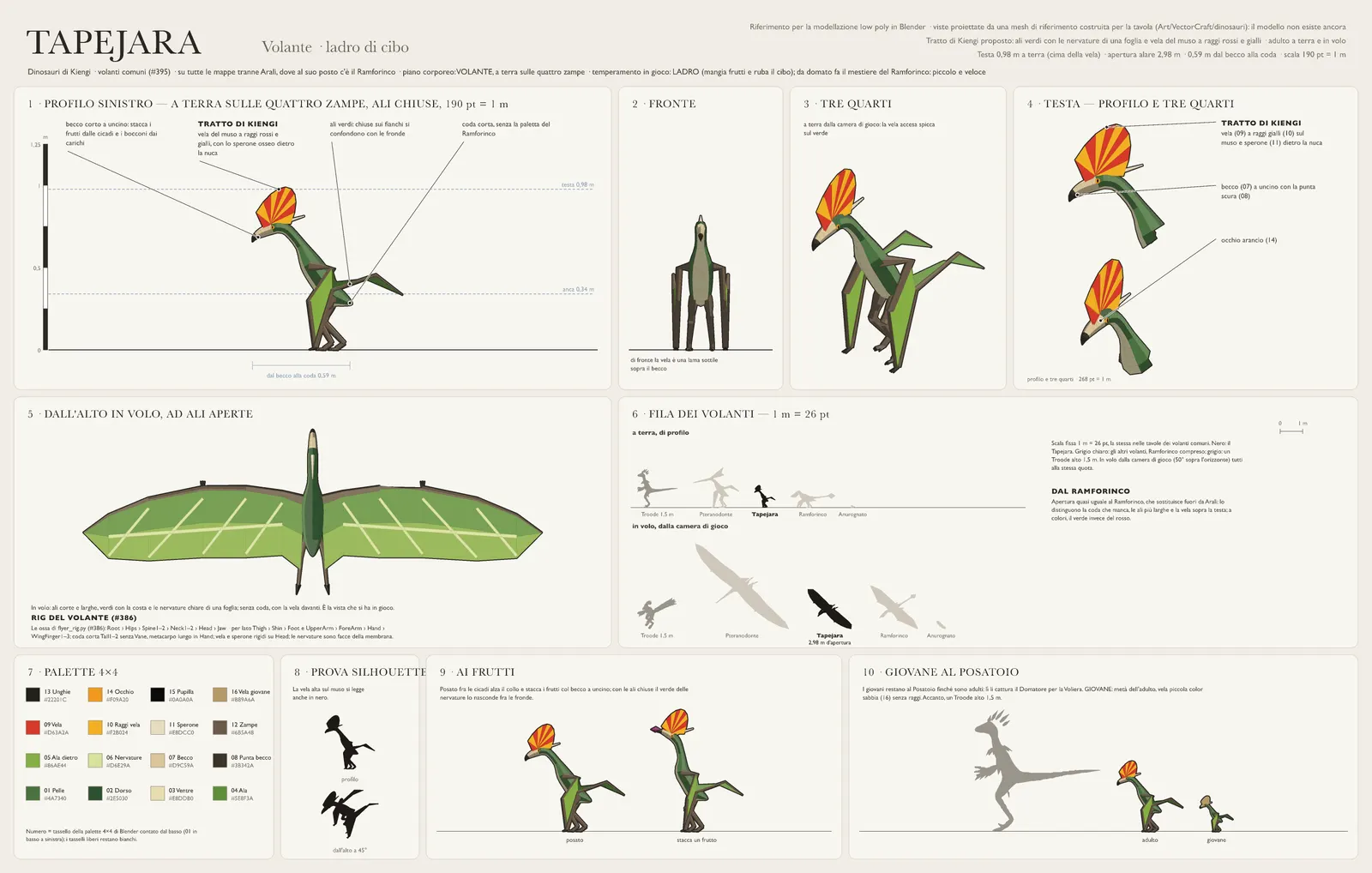 Tapejaraflyer · leaf-shaped wings and a sail on the snoutThief
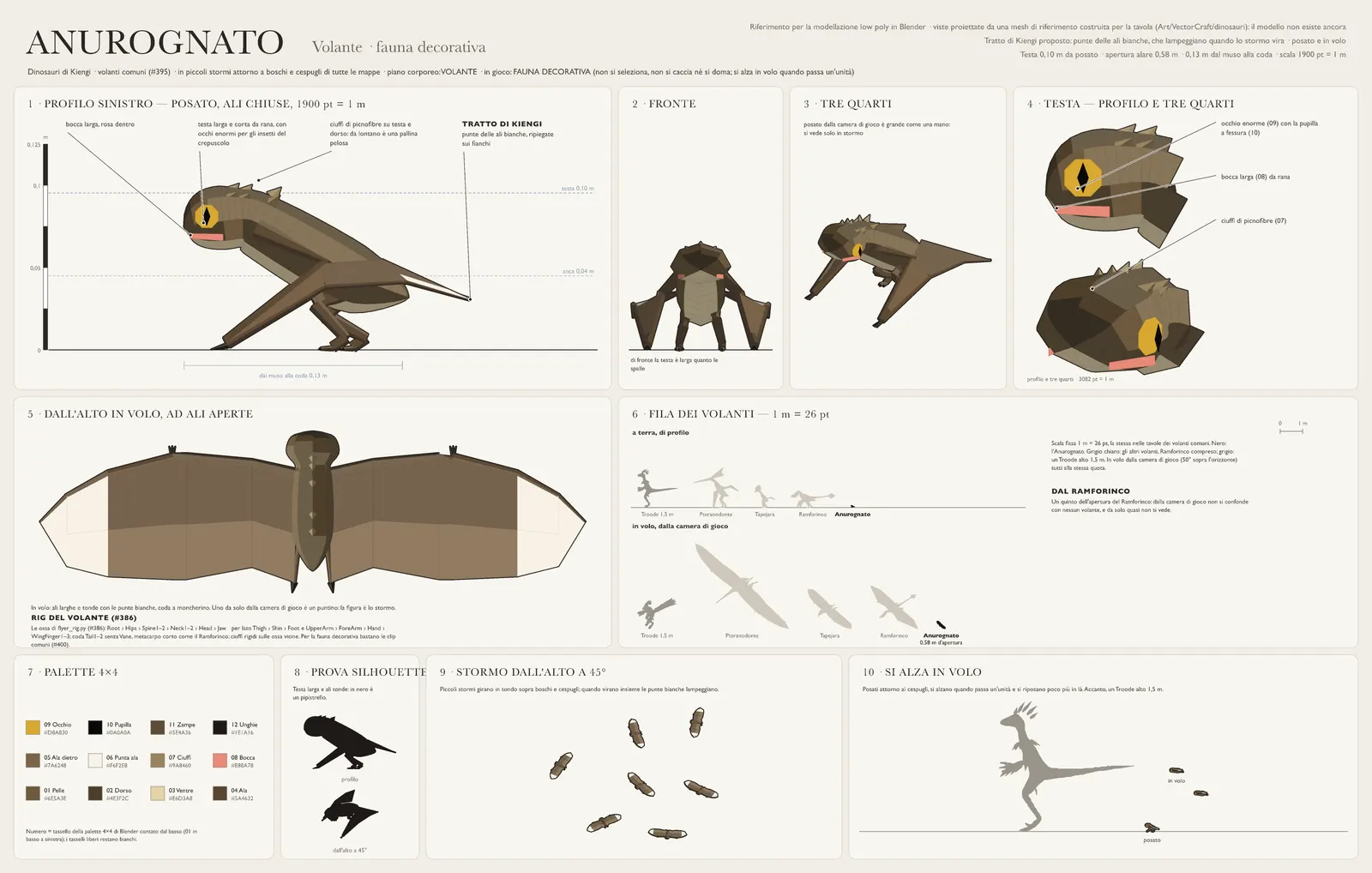 Anurognathusflyer · flocks above the woodsDecorative
The Eclipse Prey
M15 brings a species that lives on no map: the Kosmoceratops comes in from the edges only on the night of the Eclipse, with its horns glowing, and leaves at dawn. It stays outside Tension and Extinction, the predators of that night hunt it, and whoever brings it down takes its horns, the material of the Great Offering.
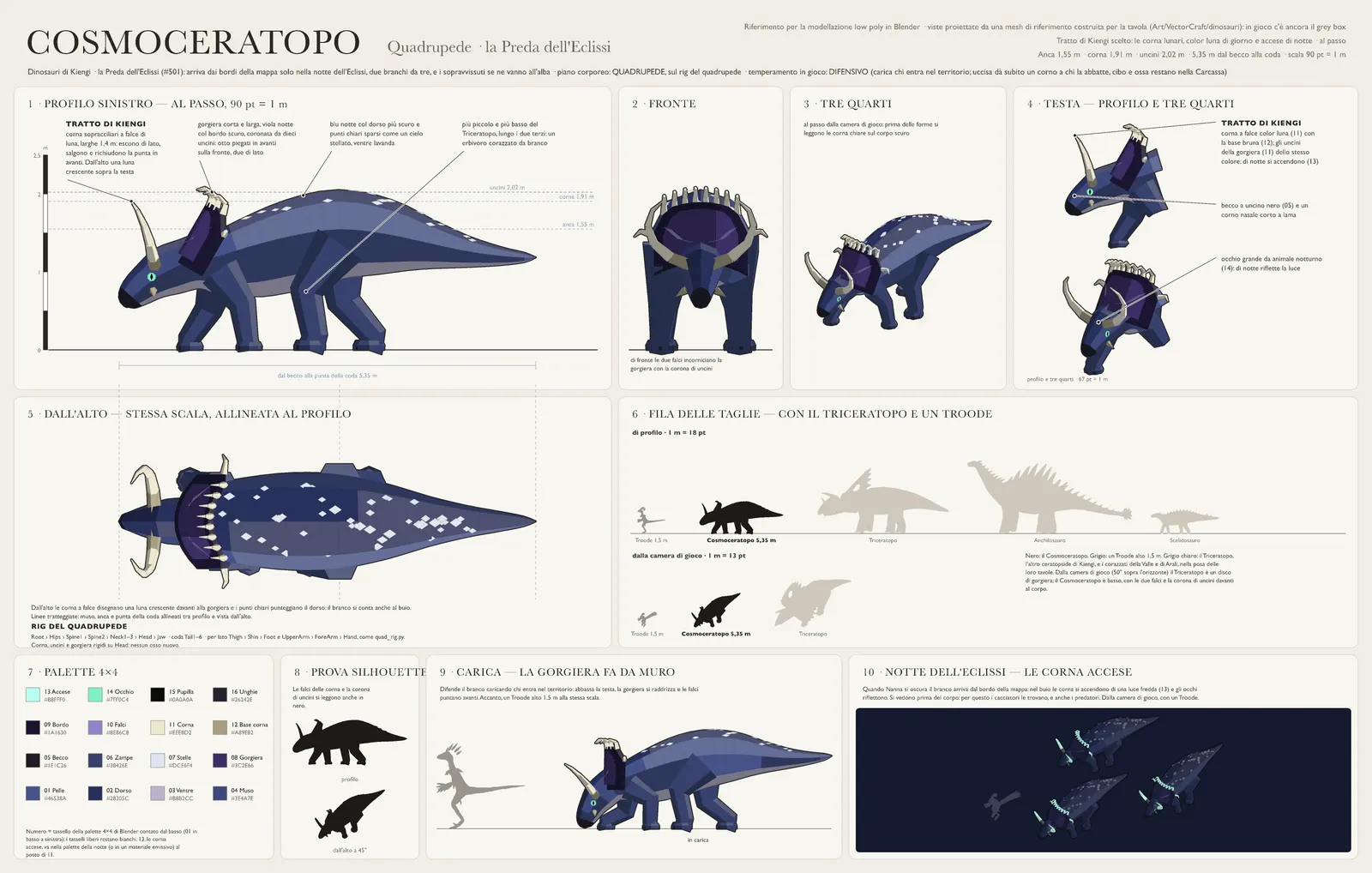
The reptiles of the open sea, Mosasaurus, Plesiosaurus and Liopleurodon, come later, with the Harbor and the navigable water.
The fauna · Ornithopods
Dryosaurus
Everyone's prey and the first tamed species
A slender biped with a horizontal body, the first herd beside every Camp. It is easy food for a single hunter, the favorite prey of raptors and Dilophosaurus, and the first species a tribe learns to tame.
Kiengi trait
Stripes that cross back and flanks from the neck to the tip of the tail, and rows of bioluminescent dots that light up at night, stronger in the male.
Appearance
S-shaped neck, a short, tall head with a big eye ringed in a pale color and a gray horny beak, slender five-fingered arms, long digitigrade legs and a long, thin tail.
- Female: green with straw-colored and dark green stripes, cream belly.
- Male: turquoise with orange and red stripes, a magenta throat and a crest of magenta and red spines from the head to the nape.
In game
You hunt it alone from the first level and it yields 100 meat. From the Town the Tamer captures a young one, if the species' tension toward his tribe is below 30; the young one grows in the Pen and becomes a Tamed Dryosaurus. A ready Dryosaurus is also the mount of the Rider.
The fauna · Theropods
Gallimimus
The runner of the fauna
Very long legs, a short, light body, a long neck and a small head with a toothless beak. It lives in herds in the glades and is fast food to hunt, if you can catch it.
Kiengi trait
Dark, sharp vertical bands, like a zebra, on neck, trunk, thighs and tail, plus a mask over the eye. In a running herd the bands overlap and the predator loses the single animal.
Appearance
- Female: dark brown bands and a gray-blue muzzle.
- Male: a bit bigger, almost black bands, vermilion skin on muzzle and throat and arm feathers with vermilion tips.
In game
You hunt it in a group from the first level. It is one of the prey of Velociraptor and Dilophosaurus. After the MVP it is raised in the Pen for eggs and hides, and it is the next species to ride.
The fauna · Ornithopods
Parasaurolophus
The guardian of the glades
A massive herbivore that walks on all fours and rises on its hind legs when on alert. It is territorial: it charges the hominids that enter its territory.
Kiengi trait
A straight tubular crest, with a flattened hexagonal section, the color of the body with a signal-colored tip, and a bare throat: at rest a brown-orange fold under the neck, on alert a swollen orange sac.
Appearance
Massive body, deep neck, a wide, flat horny beak, sturdy arms with the fingers joined and a hoof-like nail, a high, stiff tail. Brown back and olive-green flanks with dark spots, pale belly. Its crest is different from that of the Crestati, so that the two silhouettes are not confused.
In game
You hunt it from level 2 and it yields 300 meat plus hides, but the herd reacts and charges. After the MVP, tamed, it becomes a sentinel that warns of incoming predators.
The fauna · Quadrupeds
Triceratops
The biggest head in the Valley
Low and heavy, with a huge head carried forward. It grazes in the woods and blocks tree cutting until it moves away; driving it off raises tension.
Kiengi trait
A giant, perforated frill, 4 m wide, with two windows ringed in yellow that look like eyes and an edge of 19 bone-colored conical spines, the same as Ankylosaurus and Velociraptor.
Appearance
- Male: slate-gray skin, 1.1 m ivory brow horns, black hooked beak.
- Female: 3.3 m frill with shorter spines, rust brown with ocher rings, 0.9 m horns.
In game
You hunt it with armed Hunters from level 3 and it yields 800 meat plus hides and bones, with high risk and tension. Tamed, from the Colony, it wears the yoke for heavy work and, with the pack saddle and a Merchant walking beside it, becomes the caravan.
The fauna · Quadrupeds
Ankylosaurus
An armor that browses from the trees
It has the armor and the club tail of the Earth ankylosaur, but on the body of a high browser. Two blows of the club kill a hominid.
Kiengi trait
The bearing of a sauropod: a long neck rising from the shoulders, a small head held high, column-like legs and an arched back. On the back, big conical spines in several rows with bone-colored tips.
Appearance
Earthy brown with a darker back and a pale belly, plates with bone-colored tips, amber eye. The long tail slopes down and tapers to a spiked club. When it defends the herd it lowers its head and raises its tail.
In game
It is the riskiest hunt among the herbivores: it charges faster than a hominid runs, and whoever enters its range does not get away. It yields 800 meat plus hides and bones, with a strong rise in tension. After the MVP, tamed, it protects pens and fields.
The fauna · Theropods
Velociraptor
The pack that circles the fire
A nocturnal pack predator, bigger than its Earth relative. At night the raptors leave the nest and circle the village of the tribe with the highest tension toward them.
Kiengi trait
Rows of bone-colored conical spines bent toward the tail, among the feathers: a central one from the nape to mid-tail, with the biggest above the pelvis, two lateral ones and a low one on the flanks.
Appearance
Purple feathers with a paler belly, wing-like arms with the feathers running down to the claws, feathered "breeches" on the thighs and a fan of feathers along the tail. Muzzle, feet and hands scaled in dark gray, a yellow plate around the eye, the sickle raised on the second toe.
In game
The light of Camp, Fire Totem, Watchtowers and Pyres keeps them away, and palisades stop them. Above 70 tension they bring the Incursions and at night they ignore the light. They cannot be tamed. A dial clock shows how long until night.
The fauna · Theropods
Dilophosaurus
The ambush among the ferns
Slimmer than the Tyrannosaurus and bigger than the raptor, it is an ambush hunter. It lives in the woods and hunts the small prey there: it makes woods and fords dangerous.
Kiengi trait
Two thin, parallel crests from the snout to the nape, scarlet with a yellow serrated edge, and an orange throat sac. When hunting, crests and sac light up and the sac swells. No collar.
Appearance
- Male: 0.45 m tall crests, olive-ocher body with brown spots.
- Female: 0.30 m rust-brown crests with an ocher edge, a smaller, dull sac.
In game
It attacks anyone who enters its range and hunts Dryosaurus and Gallimimus, leaving carcasses. It is brought down with an armed group and yields bones.
The fauna · Theropods
Tyrannosaurus
The apex predator, in a pair
In every match it is the most feared presence. It does not arrive as a timer event: it roams the map, and when it is hungry it targets the tribe with the highest Overall Tension. Next to it a Troode comes up to its knee.
Kiengi trait
A mane of stiff feathers on neck and shoulders, black at the base with bone-colored tips, up to 1 m long. At rest it lies flat; when it targets a tribe it swells and bares the ember-red throat.
The pair
- Male: roams and hunts the big herbivores; green-black skin with dark bands.
- Female: 6% bigger, stays at the nest and defends eggs and young. Short brown-black mane with gray tips, more olive skin, brick-colored throat.
In game
It can be brought down, but it takes a small army from level 4, and it leaves a lot of bones.
The fauna · Arali · Ornithopods
Camptosaurus
Arali's herd prey
Arali's Dryosaurus and Gallimimus: a herd herbivore that walks on all fours and rears up on its hind legs when alert, food for Ceratosaurus and Allosaurus.
Kiengi trait
A spare hump on the withers, bright red, for the dry interior of Arali where water is far away, and thumb spikes, long and bone-colored, which it uses to defend itself when a predator catches up.
Appearance
Golden yellow with a darker back and a cream belly, a dark horn-colored beak and the long head of a browser. The long, stiff tail has dark rings: when it flees it raises it like a banner for the herd. The Young is a little over half as long and has no hump.
In the game
Prey you hunt in a herd, like the Dryosaurus, but only as a group because of the spikes: you can hunt it from the Bivouac, it has 50 Health and leaves a Carcass worth 200 food and 50 bones. It walks on all fours at 1.3 m/s and flees on its hind legs at 5.5 m/s, tail held high like a banner; the Young has half the Health and half the Carcass. It cannot be tamed. On Mašu Island it grazes in herds of 5 on the slopes toward the coast, between the contested zones and the Ceratosaurus nests.
The fauna · Arali · Quadrupeds
Scelidosaurus
The small armored one, ancestor of two branches
A low, armored Quadruped that takes the place of the Ankylosaurus in Arali: it is its ancestor, and the ancestor of the Stegosaurus too.
Kiengi trait
Both branches of the family in a single body: rows of bone-colored conical shields from the nape to the tail, like the spines of the Ankylosaurus, and two pairs of radiating spikes at the tip of the tail, like the Stegosaurus.
Appearance
Brick red with a darker back, a dark mask over the yellow eye, a narrow horn-colored beak; the neck is already slightly raised and carries a collar of three shields on each side. When threatened it crouches and raises its tail.
In the game
Defensive: it charges whoever disturbs it, from 3 to 10 m, and lashes its tail sideways. You can hunt it from the Village like the Parasaurolophus, it has 160 Health and leaves a Carcass worth 250 food and 60 bones; its Charge does less damage than the Ankylosaurus's, and a killed head raises Tension by 15 instead of 25. It cannot be tamed. On Mašu Island it lives in herds of 4 near the range, beneath the scree.
The fauna · Arali · Quadrupeds
Stegosaurus
Plates and a spiked tail
Arali's great armored beast: it grazes in a herd, and hunting it is risky, because one blow of its tail knocks down a Hominid.
Kiengi trait
Two alternating rows of very tall plates, up to 1.2 m, with a burnt orange edge: when it defends the herd they light up red and orange. The tail ends in a ring of six spikes, where its land relative has four.
Appearance
Leaf green with dark patches, a cream belly, a small low head with a horn-colored beak; the hind legs are almost twice as long as the front ones and the back rises up to the hips. The female has lower plates.
In the game
Defensive, with the riskiest hunt in Arali, between the Triceratops and the Ankylosaurus: 320 Health, a Carcass worth 650 food and 125 bones, hunted from the Town. It charges from 3.5 to 11.5 m, but strikes with its tail: it turns its tail toward the target and every blow, 14 damage, also hits whoever is behind or beside it within 4.5 m, of any Tribe. Only whoever stands in front of the head is safe, or whoever carries an Offering. While the herd defends, the plates light up, a second palette like the Dilophosaurus hunt. On Mašu Island a guard of 4 Stegosaurus stands in every contested zone, next to the Bone Pile; the Allosaurus hunts it.
The fauna · Arali · Sauropods
Brachiosaurus
Arali's giant
The first Sauropod in the game: the almost vertical neck carries the head to nearly 13 m, where nobody else feeds. It tramples whoever disturbs it.
Kiengi trait
The arch of the nostrils becomes a tall fan-shaped crest, turquoise with a gold edge, which resounds in its calls and shows above the trees. In the female it is lower and sea green.
Appearance
Olive green with a neck of pale rings edged in dark, one every 1.1 m. The front legs are longer than the hind ones: the withers stand higher than the hips and the back slopes down toward a short tail. If a Hominid stands under it, it rears up and comes down on its front legs.
In the game
Defensive and Migratory Herd: 4 heads on the same Route as the Brontosaurus, half a ring out of phase, with 90 seconds at every stop, in the meadows ringed with araucarias. Its Charge is the trample: it rears up and comes down on the target, 20 damage, and crushes anyone around it within 4 m. It has 900 Health and can only be hunted as a group, from the Town, for a Carcass worth 2000 food and 400 bones that rots at half speed. No Predator hunts an adult: the Allosaurus takes only the Young.
The fauna · Arali · Sauropods
Brontosaurus
The great migrant
The Sauropod that never stops. It migrates constantly, and with the ice ages and the drying of the seas it has reached the other lands: it lives on Arali and beyond, the only one of the species of Arali.
Kiengi trait
Pale V-shaped saddles on the back, a different sequence for every head: the Tribes that live off the herds recognize the herd to follow that way. Along the neck and back runs a row of dark horny spines.
Appearance
Steel blue with a cream belly and pale yellow saddles. The neck is long and almost horizontal, for browsing the low ferns along the road; the 11 m tail ends in a thin whip, which it raises and cracks against Predators.
In the game
Defensive and Migratory Herd: it wanders the map on its Route, at the same speed as the Brachiosaurus, and charges whoever attacks or disturbs it. Standing still within reach it turns its tail toward the target and cracks it: every lash, 18 damage, hits whoever is behind or beside it within 9 m. It has 750 Health and can only be hunted as a group, from the Town, for a Carcass worth 1700 food and 340 bones that rots at half speed; Predators hunt only its Young. In the game every head has its own sequence of saddles, one of six, Young included. There are 6 on Mašu Island and 3 or 4 in the Buranunu Steppes, where the Route passes behind the bases.
The fauna · Arali · Theropods
Ceratosaurus
The hunter of the gulf shores
Arali's mid-sized Predator: it hunts small Prey along the gulf shores and in the fords, swimming too.
Kiengi trait
A blade-like nasal horn, orange in the male and ocher yellow in the female, and orange bosses above the eyes; a continuous crest of black plates from the nape to the tip of the tail, and a tall, flat tail like an oar.
Appearance
Petrol blue with dark vertical bands, a cream belly, long teeth that show even with the mouth closed. In the water the head with its horn, the crest of plates and the oar of the tail stay above the surface.
In the game
Predator in a group of 3 with a Nest and regrowth, beneath the Allosaurus as Velociraptor and Dilophosaurus are beneath the Tyrannosaurus. It hunts by day, one meal a day: Camptosaurus, Dryosaurus and Scelidosaurus. At Night it stays in its Territory, except on the night of the Eclipse. It has 110 Health and bites for 10 per second; wounded below 15% it returns to the Nest to recover. You can hunt it from the Bivouac, Carcass worth 80 food and 60 bones, and it cannot be tamed. On Mašu Island the Nests are along the coast, one at the side of every base, with a path through the woods to the nearest base.
The fauna · Arali · Theropods
Allosaurus
Arali's apex Predator
Arali's Tyrannosaurus, two thirds of its length but lighter and faster: it hunts the great herbivores, Stegosaurus and Sauropods included.
Kiengi trait
The lacrimal horns, which in the land relative are bosses a few centimeters high, become two blades 0.44 m tall above the eyes, bright red in the male and ocher yellow in the female.
Appearance
Ocher orange with a rust-colored back and dark transverse stripes from the nape to mid-tail, cream belly. The arms are long, with three hooked claws to hold large Prey. When hunting it lowers its neck, raises its tail and opens its jaws wide.
In the game
Apex Predator: a pair with a Nest and Clutch, like the Tyrannosaurus, which by day hunts Stegosaurus, Scelidosaurus, Camptosaurus and the Young of Sauropods. The male has 1000 Health and bites for 30 per second, the female has 1200 and defends the eggs; as an apex Predator it ignores the Light. Wounded down to 35% it abandons the hunt and returns to the Den. When hungry it goes to the village, by day and by night, but it picks the Tribe with the highest Tension toward Allosaurus, not the Overall Tension like the Tyrannosaurus; it also comes out on the night of the Eclipse. You can hunt it from the Colony, Carcass worth 600 food and 200 bones. On Mašu Island there is one Den per side, between the range and the center.
The fauna · Arali · Flyers
Rhamphorhynchus
The thief of the gulf
Arali's Flyer, in place of the Tapejara: it fishes in the gulf, steals food from uncovered Drying Racks and lives beside the Gliders on the cliffs of Mašu.
Kiengi trait
A diamond-shaped paddle at the end of the tail, orange with a false eye: in flight the Predator bites the tail and not the head. Under the jaw a pelican-like throat pouch carries off fish and stolen food.
Appearance
Petrol blue body, fire red wing membrane with a pale trailing edge, long comb-like teeth bent forward. On the ground it walks on its hands with its wings folded; in flight the wingspan reaches 3.2 m. The female has a smaller paddle.
In the game
Thief, the Temperament of the Flyers: it steals food, 4 at a time, and carries it to the Roost in its throat pouch, which in the game swells while it carries it. Small and fast, 9 m/s in flight, with 30 Health; you can hunt it from the Bivouac for a Carcass worth 30 food and 6 bones. On Mašu Island the Roosts are on the scree at the foot of the range. You tame it in the Aviary: one slot, 40 Health and 14 m of sight, and from there it explores and steals from the other Tribes.
The fauna · Flyers
Pteranodon
The soarer of every map
The large Flyer, the Thief of every land, Arali included: it glides for a long time above the village and dives onto the load.
Kiengi trait
The backward crest is tuning-fork shaped: two bone shafts with a purple sail edged in yellow, in the male only. The female is smaller, four fifths of the male, with a short bone-colored shaft.
Appearance
Long toothless beak, short tail, slate gray soaring wings with a pale band before the black tips. On the ground it walks on its hands, knuckles down and the membrane gathered under the raised wing finger.
In the game
Thief: it steals 8 food at a time within 80 m of the Roost, then rests a minute and a half. It is slower than the Rhamphorhynchus, 7 m/s in flight, but sees farther; it has 60 Health and you can hunt it from the Bivouac for a Carcass worth 60 food and 12 bones. Every base in the Northern Hills, the Steppes and the Valley has a Roost of 2 Pteranodon nearby; on Mašu Island the Roosts are on the scree of the range. Tamed in the Aviary it takes up 2 slots, has 90 Health and 20 m of sight: the Tribe's best Scout.
The fauna · Flyers
Tapejara
The leaf that steals
The small Flyer of every map except Arali, where the Rhamphorhynchus takes its place: same trade, different silhouette. It eats fruit, but at the village it steals food like the others.
Kiengi trait
The wings are green, with the midrib and veins pale like a leaf: perched among the fronds it vanishes. On its snout it carries a sail of red and yellow rays, with a spur behind the nape.
Appearance
Short hooked bone-colored beak, for picking fruit, and a short tail. The Young is half the size of the adult, with a sand-colored sail and no rays.
In the game
Thief with the Rhamphorhynchus's numbers: it steals 4 food at a time within 60 m of the Roost, flies at 9 m/s, has 30 Health and leaves a Carcass worth 30 food and 6 bones. Every base in the Northern Hills, the Steppes and the Valley has a Roost of 3 Tapejara nearby, on the opposite side from the Pteranodon one. Tamed in the Aviary it takes up one slot, has 40 Health and 14 m of sight.
The fauna · Flyers
Anurognathus
The flocks above the woods
The first animal of the Ambient fauna: small flocks that circle above woods and bushes and settle around them. Sight only: they cannot be selected, have no Health and do not count toward Tension.
Kiengi trait
The wing tips are white and flash together when the flock banks.
Appearance
A broad frog-like head with enormous eyes and a wide mouth, tufts of down, a stub tail, broad round wings. From the game camera a single one is a speck beside the trees: what you see is the flock.
In the game
Flocks of seven, on every map: one for every so many woodland and undergrowth plants on generated maps, one beside each of the 12 groves of the Valley. A Unit passing within 7 m makes them rise: they circle above the crowns and settle a little farther on, on the opposite side. Only the Units the player can see count, so a flock rising does not betray an enemy under the fog of war.
The fauna · The Eclipse Prey
Kosmoceratops
The Eclipse Prey
A low ceratopsian, two thirds the length of the Triceratops, that lives on no map: it comes in from the edges only on the night of the Eclipse and leaves at dawn. Its horns light up in the dark and are seen before the body, by hunters and by predators alike.
Kiengi trait
The lunar horns: two sickle-shaped brow horns, 1.4 m across, that from the front and from above draw a crescent moon over the head. Moon-colored by day, at night they light up with a cold glow, together with the crown of ten hooks on the edge of the frill.
Appearance
A night-blue body scattered with pale spots like a starry sky, a lavender belly, a short violet frill with a dark edge, a short blade-like nose horn, a black hooked beak and a large sea-green eye that reflects the light at night. Male and female look the same. From the game camera it cannot be mistaken for the Triceratops, which is a disc of perforated frill: the Kosmoceratops is low, with the two sickles and the crown of hooks in front of the body.
In game
At the Dusk of the night of the Eclipse, when Nanna darkens, two herds of three come in from the edge of the map farthest from the tribes' buildings, and walk to their Territory, 40 m further in: the Prey arrives, it does not just appear. At dawn they go back to where they came in and leave the map.
It is Defensive: that night it charges anyone who enters its Territory on sight, head down, with the frill as a wall. It has 150 Health, can be hunted from the Bivouac and leaves a Carcass of 300 food and 60 bones; whoever lands the killing blow on an adult, hominid or building, takes a horn at once, which goes into the tribe's stock and pays for the Great Offering. The dilemma of the night is sounding the Horn or sending the Hunters into the dark.
It stays outside Tension: wounding or killing it raises nothing, it accepts no Offerings, it does not go extinct and it does not count for the Sanctuary or for the Overall Tension. Every predator that hunts eats it, though: on the night of the Eclipse, those that come out and have not eaten yet chase the Kosmoceratops they scent within 50 m, and so part of the predators leave the villages alone. The AI tribes do not hunt it.
The game
How to play
Gather, build, level up, fight, and meanwhile nature answers
The loop is the one from Age of Empires: gather, build, level up, fight the rival tribes. Alongside it, the ecosystem reacts to each tribe's choices through Tension. Every match, even in single player, is played against AI-controlled tribes.
Start of the match
- Camp: the heart of the village, with the campfire that keeps raptors away at night. Depot for all resources, Hatching of hominids, +5 Population.
- Three Gatherers and a Scout, and a stock of 100 food and 100 wood.
- Surroundings: berries and woods nearby, a quarry at medium distance, a small herd of Dryosaurus to hunt and a raptor nest far away. On generated maps the starting kit also places a Bone Pile 50–70 m away, outside the territories, like the gold in Age of Empires, and a Fish Shoal in the pool near the base.
- Obsidian: from M10 every tribe has three Obsidian Deposits on its three nearest points, on old lava flows; one halfway to the center, the others toward the border with the neighboring bases, to be defended.
Resources
Every hominid carries 10 units and drops them at the nearest Depot: building Depots near the sources is the first optimization, as in Age of Empires.
Only Gatherers gather: military units hunt, but the prey they kill stays there as a Carcass for the Gatherers. When a node runs out, the Gatherer moves to one of the same type within 20 m; if there is none, it drops what it carries, goes back to the Camp and waits among the idle gatherers, instead of wandering off from the village on its own.
Every job has its own animation and its own tool, which appears in hand only while the hominid works at the node or the Construction site: basket for berries, Fields and carcasses, axe for wood, pick for stone and obsidian (with a flint or black-glass head after the pick Upgrades), hammerstone for flint, stick for prying off bones and mallet for building and repairing. Walking, carrying a load to the Depot or fleeing, the tool disappears. The job sheets are in the pages of the Troodi and the Dromei.
| Resource | Source | Use | Risk with the dinosaurs |
|---|---|---|---|
| Food | berries, which do not regrow once gone; hunting, Fields, Fish Shoals, carcasses | Hatching, Training, Offerings to the dinosaurs | hunting raises the species' Tension; carcasses attract carnivores, and Sarcosuchus and Spinosaurus bite whoever fishes in their Territories |
| Wood | trees, which regrow at dawn if living ones remain around them | buildings, palisades | cutting in the herbivores' Territories raises Tension |
| Stone | quarries | advanced buildings | the best quarries are close to the nests |
| Flint | outcrops | Warrior and Hunter weapons | easy to find near every base |
| Bones | carcasses and Bone Piles, one in the starting kit | the evolution from the Town: Pen, Bone Weapons, Colony and City, Upgrades | rich Bone Piles are often in the predators' Territories |
| Obsidian | deposits on the flows, 400 each, which reappear elsewhere once depleted | Colony (100) and City (150), Breaker, Obsidian Upgrades | new deposits appear wherever they happen to, even far away or in Territories |
Obsidian
The sixth resource, volcanic glass: Kiengi has plenty of volcanoes, so it has no fixed spot. It is in the bar from the start, but like a mineral it can only be broken off with a strong enough pick: you need the Flint Picks, the Stone Store Upgrade from the Town, and the Obsidian Picks, from the Colony, are in turn needed for Sky Iron. It is deposited at the Stone Store and at the Camp, and without picks it only arrives from the Market, caravans and thefts by flyers.
The generator picks four possible points per base, in its slice of the map. A depleted deposit leaves a Spent Flow and, after one or two days, a new one appears on a random free point, with no warning: you only find it by exploring, and every tribe, the AI included, knows a deposit only after seeing it. This way the search pushes you away from home.
Amber and hides come after the MVP. Sky Iron, from the Meteorites of M15, is not a resource like the others: you carry one fragment at a time, it cannot be traded and it shows up in the bar only from the first fragment. The same goes for the horns of the Eclipse Prey, which stay in the bar as long as the tribe has some.
The Carcass
A slain prey leaves a Carcass, and you can tell the species: the Carcass has the silhouette of its body plan, theropod, ornithopod, quadruped or sauropod, with the colors of the species' body, back and belly, while flyers and the Kosmoceratops have their own. As the food goes down, whether it is butchered or rots, it goes through four stages: fresh above 80% of the food, bloated down to 55%, open down to 30% and then stripped, with the skin darkening. When the food is gone the pile of bones remains, the same for every species, and whoever was butchering it moves on to the bones by themselves, after unloading the food.
Population and combat
Hominids are born through Hatching at the Camp (50 food, 20 seconds). The maximum Population is the lower of the Housing (Camp and Huts, +5 each) and the village level's cap: 20, 35, 50, 75 and 100. So the useful Huts are at most 3 at the Bivouac, 6 at the Village, 9 at the Town, 14 at the Colony and 19 at the City: beyond that, the Hut cannot be placed, and if the Housing is not enough for the hominids of the next level, the condition says so.
A unit is born in front of the entrance of the building that hatches or trains it, or at the rally point if the tribe has set one with a right-click on the ground, and units that have just been born stand side by side instead of on top of each other. With the building selected the rally point shows: a small flag in the tribe's color, with a line of dots from the building.
Military units form a triangle: Archer beats Warrior, Warrior beats Rider, Rider beats Archer. The Gatherer is weak and the Tamer does not fight.
| Role | From | Where | Cost | What it does |
|---|---|---|---|---|
| Hunter | Village | Camp | 40 food, 25 flint | the specialist against dinosaurs: hunts prey and shoots up to 9 m |
| Warrior | Village | Hunters' Lodge | 50 food, 30 flint | melee, ×1.5 against the Rider and against buildings |
| Archer | Village | Archery Range | 40 wood, 25 flint | shoots up to 12 m and sees as far, ×2 against the Warrior; weak against buildings and dinosaurs, does not hunt |
| Rider | Town | Pen, with a Dryosaurus ready | 30 food, 20 flint | fast, ×2 against Archer and Hunter (see Rider) |
| Breaker | Colony | Hunters' Lodge | 60 food, 40 obsidian | slow, obsidian-bladed mace ×4 against buildings, weak against units; takes double damage from ranged attackers, until it has the Shields |
| Sky Warrior | Colony | Sky Forge | 80 food, 40 obsidian, 1 Sky Iron fragment | melee, outside the triangle: ×1 against units, buildings and dinosaurs, Health 150 and a hit of 12 every 1.2 s |
With M10 the Hunter leaves the triangle to the Archer and becomes the specialist against dinosaurs, and tearing down buildings becomes the Breaker's job: five Breakers tear down a Camp in about twenty seconds, five Warriors in more than thirty. Without Shields it takes four of them to bring down a Watchtower, so it needs an escort.
The Scout only explores, like the mounted scout of Age of Empires: fast, with 18 m of sight and little Health, it does not gather, build or fight. Every tribe has one at the start, and the Camp hatches another for 50 food only if the tribe has lost it. The Explore command sends it off alone toward the nearest reachable fog of war on foot, away from predators in sight and from the remembered fire of enemy defenses; it warns you of the first enemy Camp it sees and, once the fog of war is done, goes back home. If it dies on the way, that's fine: you make another.
From the Town on, the tamed flyers of the Aviary fly over terrain and woods: with the right click they explore, and on an enemy Depot or a loaded Gatherer they steal and bring the loot to the Aviary. In the air they are hit only by Hunters and Towers.
AI tribes attack in two ways. From the Town they send Raids: 2–4 light units, Riders first, then Archers and Hunters, against the isolated Gatherers and Construction sites of the nearest enemy tribe, not necessarily the player; they retreat at half Health and come back every 4–6 minutes. From the Colony the Waves set out, the big attacks, with at least 11 minutes between two Waves from the same tribe; their Breakers target the Towers and the Camps that shoot. The AI contends for obsidian: it researches picks as soon as it can, gathers only from the deposits it has seen and looks for new ones with the Scout.
Dinosaurs in everyday life
- Automatic Alert: when a predator gets close, hominids run to shelter, a Watchtower included.
- Alarm Horn: it sends every Gatherer to the nearest Camp, even those that were fleeing toward a Tower: they go in, unload and stay inside as long as it sounds. If that Camp collapses they go to the other one, and when the last one collapses the Horn stops by itself. Military units, Scout, Tamers and caravans stay where they are. While it sounds, the red plate «The Horn is sounding» sits above the minimap.
- Hunters: they hunt prey, not the big carnivores: they flee from Sarcosuchus, Spinosaurus and Tyrannosaurus, unless sent to attack by order. Warriors and Riders stay to defend.
- Grazing: a Triceratops in the woods blocks cutting until it moves away.
- Day: even without high Tension, a pack of predators attacks the isolated hominid it sees, outside the Light, with no companions within 10 m and more than 40 m from the tribe's buildings. Whoever works in a group or near home is safe.
- Carcasses: prey left on the ground attracts the nearest pack of carnivores, which bites whoever is butchering it.
- Night: raptors circle the most hated village; light and palisades keep them out.
- Offerings: leaving food for a species lowers its Tension.
- Woods: a felled tree leaves a stump. At dawn, if at least 2 living trees remain within 20 m, it sprouts and in 2 minutes is full again, in the same place; while it grows it cannot be gathered.
The Eclipse
With M15 the sky comes into the match, in every Skirmish and for all tribes, but not in the Tutorial: the Eclipse is the threat you see coming, the Meteorite the opportunity you look for. The first gives materials that get used up, the second knowledge that stays. No scores: the game never measures how well an event went.
The Eclipse is a night, between day 5 and 7 and then every 4–6 days, in which Nanna darkens, the same for all tribes. The moons of the Clock draw closer for days, and three signs fall at Dusk, each with its own sound: two days before «The moons seek each other», the day before the crescent of the night turning violet, and that very evening «Nanna darkens».
- For that night: the Incursion starts at Tension 40 instead of 70 and the Light shrinks to 60%. Tension does not change: the thresholds do, and at dawn everything goes back to how it was.
- All predators at night: even those that stay in the nest at night come out, Dilophosaurus, Ceratosaurus, the male Allosaurus, Sarcosuchus and Spinosaurus, and like the raptors they go for the tribe with the highest Tension toward them. The Tyrannosaurus stays out: in its night it does what it always does, and comes out only if it is hungry. Thieves stay at the Roost, and no predator accepts Offerings.
- Defensive herbivores: they charge anyone who enters the Territory on sight, already from Tension 40.
- Self-defense: predators killed that night within 40 m of the tribe's buildings do not raise Tension and do not give it Extinction, so the Towers do not take Balance away from whoever has lived alongside them. Whoever hunts in the dark pays as always.
- Satiety: predators that ate on the day of the Eclipse, night included, have no Hunger for two days after dawn.
- Eclipse Prey: at Dusk two herds of three Kosmoceratops come in from the edges of the map, with their horns glowing, and at dawn they leave. Whoever brings down an adult takes a horn at once, the material of the Great Offering; food and bones stay in the Carcass. The predators that come out that night and have not eaten hunt them if they scent them within 50 m, even outside their mealtime. They stay outside Tension, Extinction and Balance.
- The Horn: it saves only the workforce, and that is what pushes you to defend. The dilemma of the night is sounding it or sending the Hunters into the dark, after the Prey.
AI tribes read the signs: they sound the Horn at Dusk, gather the military units in the Light of Towers and Camp and, from Dusk to dawn, call back Waves and Raids and send no new ones. They do not hunt the Prey. In tests they lose on average 3% of their hominids in an Eclipse, never more than a third.
The Meteorites
The two gas giants of the Utu system deflect the big rocks; the small ones get through. From day 3 Meteorites fall, about two per tribe in a normal match, never on the night of the Eclipse. They fall on a random point in the slice of the map of a base, in turn, more than 40 m from buildings and reachable on foot from all bases: luck yes, avalanche no.
- Clues: a thud and the notice «A stone fell from the sky», to everyone and with no point. Then a column of smoke rising next to the Meteorite, not above it, for a day: you see it above the fog of war and on the minimap as a pale smudge, it stops at the edge of the map, and it gives the zone, not the point. No tribe, not even the AI, sees the Meteorite until it enters its Team's sight; the AI receives a 30 m circle one minute after the impact and sends the Scout there.
- The stone: a block of iron stuck in the ground at a slant, with the crust burnt by the fall, the pale break facing front and the churned earth around it. You select it with the left click, like a node: the panel tells you the fragments left, under the fog of war the ones counted last time, that it needs the Obsidian Picks and what the iron is for.
- No deadline: once the smoke thins, the Meteorite stays where it is. The deadline is the other tribes.
- Sky Iron: the only metal of Kiengi. Every Meteorite gives 2–4 fragments; a Gatherer with the Obsidian Picks breaks off one per trip and carries it to a Camp. If it dies, the fragment falls to the ground as a splinter of iron and anyone picks it up, even without a pick. It is not exchanged, not traded and not stolen.
- Explore: the Scout that finds a new Meteorite stops and stays on as its sentinel while it has fragments; at the Dusk of the Eclipse it takes shelter in the nearest Light and returns at dawn.
The Sky Forge
Sky Iron has a single building, the Sky Forge, common to all races and one per tribe. Kiengi does not smelt metal: in the Forge the meteoric iron is hammered on the basalt anvil, as the Inuit did with the Cape York meteorite. It appears in the list from the first fragment, even one picked up from the ground, and it is built from the Colony, the level of the Obsidian Picks: 150 wood, 100 stone, 100 obsidian and 5 fragments, 60 s, Health 700, 4 × 4 m. If it collapses, it is rebuilt without paying the fragments again, otherwise a successful Raid would wipe out all the Meteorites found. Sky Iron appears in the resource bar from the first fragment. Sheets and styles in Buildings.
- Sky Warrior: the elite unit, a role common to all races that is trained only at the Forge, in 30 s, with the iron blade on the race's mesh. Melee and outside the role triangle: no bonuses and no weaknesses, worth more than any of them and limited by iron. Health 150, one hit of 12 every 1.2 s (about two and a half Warriors); it costs 1 fragment, 80 food and 40 obsidian, counts 1 in the Population and receives the Weapons and Shields of the Workshop, but the blade stays iron. The name is always written in full: a Warrior rule does not apply to it unless it names it.
- Iron Tools: the economic Upgrade, 2 fragments and 100 obsidian, 45 s: Gatherers gather every resource 15% faster, on top of axes, picks and hoes. On the Forge they show as a rack with an iron axe, pick and hoe.
- Iron Scales: the military Upgrade, 2 fragments and 100 obsidian, 45 s: all military units take 15% less damage from every source. On the Forge, the scale corselet on its stand.
A Sky Warrior that dies loses its fragment; the two Upgrades, instead, stay forever, and they are what keeps the rule of the Meteorite that gives knowledge that stays, competing with the Warrior for the same iron. Without fragments the order says «Not enough Sky Iron». The AI tribe builds the Forge as soon as it has the Colony and 5 fragments, then researches the Tools, then puts a Sky Warrior in every army as long as it has iron, and the Scales last; without fragments it gets on with the rest. In 90-minute AI-versus-AI tests one tribe in three gets the Forge, about half an hour after the Colony: what holds it back is gathering the iron, not the cost.
Ships and harbors
From M14 every generated map has a stretch of Deep Water common to all bases, and water can split the land, so expansion goes by sea as well. On rivers the Bridge is thrown from the Village between the two banks, as long as the water, and can be torn down; from the Town the Harbor trains the Raft, which carries five seats across the water, the Fishing Canoe, which fishes the Deep Shoals, and the War Canoe, which shoots at ships, the coast and flyers. All in Harbor and ships.
The game
Tension
Every tribe pays for how it treats the dinosaurs
Above the Temperaments sits Tension, a value from 0 to 100 for every species–tribe pair. It is the mechanic that sets the game apart from a classic RTS: the same species can be docile with one tribe and furious with the one next door.
Rises with
- hunting the species, much more if you kill Young or females near the nests
- clearing woods or building in its Territory
- stealing eggs and making noise near the nests
- the last individual killed of a species, which raises the Tension of all the species tied to it
Falls with
- food Offerings, and more so the Great Offering with the horns of the Eclipse Prey
- respecting borders
- protection from predators
- sustainable hunting: old or wounded individuals do not raise it
Offerings and the Great Offering
A hominid carries food to a species, on the dinosaur or on its Territory, and on arrival that species' Tension toward the tribe goes down by 10. With M15 there is also the Great Offering, which costs the same food plus one horn of the Eclipse Prey and lowers it by 40. The command appears next to Offer only when the tribe has horns; the two Offerings share the wait for the same species, and the horns of an Offering that does not arrive are lost, like the food. You get horns only by bringing down an adult Kosmoceratops on the night of the Eclipse.
The Eclipse Prey stays outside Tension: wounding or killing it raises nothing, it accepts no Offerings, it does not go extinct and it does not count for the Sanctuary or the Overall Tension. The AI tribes do not use the Great Offering.
How to win
You play in fixed Teams, and victories count for the Team.
- Conquest: tear down all the enemy Camps.
- Balance: a tribe keeps its Sanctuary, the City building, standing, with the Tension of all species toward it under 50 for a set time. Like the Wonder in Age of Empires, it is announced to everyone and you stop it by tearing it down.
The game
The village
From Bivouac to City in five levels
Like the ages in Age of Empires, village levels spread buildings, units and Upgrades across the whole match. To level up you need three things together: a minimum number of Hominids, the resources to spend and a special condition. Advancement takes time, and meanwhile the village is vulnerable.
| Level | Buildings unlocked | Units unlocked | Cap |
|---|---|---|---|
| 1 · Bivouac | Camp, Hut, Wood Store, Drying Rack, Fire Totem | Gatherer, Scout | 20 |
| 2 · Village | Hunters' Lodge, Archery Range, Stone Store, the race's Sacred Place, Field, Palisade with Gate, Dock | Hunter, Warrior, Archer | 35 |
| 3 · Town | Pen, Aviary, Market, Watchtower, Weapon Workshop | Tamer, Tamed Dryosaurus, Rider, tamed Flyers | 50 |
| 4 · Colony | Extra Camp, Stone Walls with the Wall Gate, Tamed Stable, Sky Forge | Merchant, Tamed Triceratops, Caravan, Breaker, Sky Warrior | 75 |
| 5 · City | Pyre, the race's Sanctuary | — | 100 |
With M12 the city grows like in Age of Empires II: every building has a function, economy, army or defense, and every level unlocks at least three, with no needs for the inhabitants. Food has a steady source before the Town (Drying Rack at the Bivouac, Field and Dock at the Village; berries run out and do not grow back), and defenses come sooner: Palisade and Gate at the Village, Watchtower at the Town.
Advancement
| Step up | Hominids | Resources | Special condition | Duration |
|---|---|---|---|---|
| 1 → 2 | 10 | 200 food, 300 wood | build the Fire Totem (100 wood and 60 stone, no bones) | 60 s |
| 2 → 3 | 15 | 400 food, 600 wood, 150 stone | Hunters' Lodge and Stone Store finished | 75 s |
| 3 → 4 | 20 | 500 food, 250 wood, 100 stone, 80 bones, 100 obsidian | 2 finished buildings, of different types, among Pen, Market, Weapon Workshop and Watchtower | 90 s |
| 4 → 5 | 30 | 400 food, 200 wood, 150 stone, 100 bones, 150 obsidian | Stone Walls (one segment is enough) or Tamed Stable finished, and a Tamed dinosaur | 120 s |
Starting values for balancing. The reference curve is that of the ages in Age of Empires II: levels 2, 3, 4 and 5 around minutes 6, 12, 20 and 28, with a full match lasting 45 to 60 minutes. After the Aviary and the M10 costs, in AI-versus-AI tests with 2 Tribes the Colony arrives around minute 25 and the City around 55: the curve needs a review with a played match. The next level and its conditions, checked off or missing, are always in the HUD, under the level plate.
Upgrades
An Upgrade is researched only once, in one building, and applies to the whole Tribe, including what is already hatched or built. Some bring a building to the next Grade.
| Building | Upgrade | Level | Effect |
|---|---|---|---|
| Wood Store | Flint Axes · Bone Axes | 2 · 4 | wood +20% · +15% |
| Fire Totem | Living Fire | 3 | light of Totem and Camp +5 m |
| Camp | Warm Clutch | 3 | Hatching 1.25 times faster |
| Camp | Obsidian Spikes | 4 | Palisade and Gate take 3 Health from whoever hits them in melee |
| Stone Store | Flint Picks · Sledges | 3 · 4 | stone, flint and bones +20%, and obsidian can be mined · load from 10 to 14 |
| Stone Store | Obsidian Picks | 4 | obsidian +20%, and Sky Iron can be mined |
| Weapon Workshop | Bone Weapons · Shields | 3 · 3 | bone weapons · Warrior and Breaker take half the damage from ranged attackers |
| Weapon Workshop | Obsidian Weapons · Tempered Weapons | 4 · 5 | Warrior, Hunter, Archer and Breaker +2 attack, black tips · attack +2 |
| Drying Rack | Woven Baskets · Fire Drying | 4 · 5 | berries and carcasses +20% · carcasses rot at half speed |
| Pen | Wide Pen | 4 | from 3 to 5 slots, growth 1.5 times faster |
| Palisade | Reinforced Palisade | 4 | double Health, Gate included |
| Field | Bogeyman | 3 | wild Thieves don't steal from Fields or their farmers |
| Field | Bone Hoes | 4 | Field yield +25% |
| Watchtower | Obsidian Darts · Stone Tower | 3 · 5 | ranged damage +2 · Health ×1.6, damage +2, range +2 m |
| Sky Forge | Iron Tools · Iron Scales | 4 · 4 | gathering of every resource +15% · military units take 15% less damage |
The obsidian Upgrades come from M10: Shields (100 wood and 100 bones, no obsidian, because they must stop the Village Archer), Obsidian Darts (100 wood, 75 obsidian), Obsidian Weapons (150 food, 100 obsidian) and Obsidian Spikes (100 wood, 100 obsidian); Obsidian Picks cost 100 wood and 100 obsidian. You can see them on the models: the Darts quivers on the Tower, the Spikes blades on Palisade and Gate, the black tips and big shields on the Hominids. The iron Upgrades come from M15 and cost 100 obsidian and 2 Sky Iron fragments each.
The game
Buildings
From the hides of the Bivouac to the stone of the City, in the Tribe's color
Buildings carry the Tribe's color and are shared by all Races, except the Sacred Place and the Sanctuary, which each Race builds its own way. As in Age of Empires they change look when the village levels up, even those already built. The 3D models come from the same geometry as the reference sheets.
While you place a building, the preview is its finished model, in the style of the level and with the Tribe's Grade, green if you can build and red if you can't; Palisade and Walls show the segments as you drag. A building that gives Light shows on the ground the circle it will light once finished, at any hour, next to the Lights the tribe already has. A Palisade or a stretch of Walls that starts within 1.5 m of the free end of a stretch of the same line starts exactly there, even at 45°, so lines built at different times join without gaps; the ghost shows it before you click.
Foundations start at a quarter of the finished building's Health and gain the rest as the work goes on: a freshly placed Construction site does not fall at the first blow of a Raid, and the builders have time to defend it.
Bivouac
Village
Town
Colony and City
One style per level
Only the Camp levels up; the other buildings follow the Tribe's level and show from afar how far along each Tribe is. There are five styles, one for each level at which the building exists: the Hut has five, the Lodge four, the Market three, the Watchtower two, Pyre and Sanctuary one. They follow the materials of Kiengi: hides and lashed poles at the Bivouac, worked wood, bone and rope in the middle levels, dry-stone at the City.
- Grades: Reinforced Palisade and Gate, Stone Tower and Wide Pen have a model in every style; the other Upgrades only add objects on top of the level's model, like racks and baskets.
- Transition: during Advancement the Camp shows the works in progress; at the end all the Tribe's buildings switch to the new style with a puff of dust.
- What doesn't change: the footprint, the building's mark (stack, piles, fire, banner), Construction site and rubble.
- New levels: Palisade and Gate, now from the Village, and the Watchtower, now from the Town, show their first style until sheets and models have the one for the extra level.
For later: Tannery, with hides, and Granary. The Bridge, from the Village, has a single style for every level, and its sheet is in Harbor and ships. Kiengi does not smelt metal, and weapons are made in the Workshop. The only exception is the M15 Sky Forge, where the Sky Iron of the Meteorites is hammered and the Sky Warrior is trained.
The game
Rider and Caravan
Hominid and dinosaur, a single Unit
There are no horses on Kiengi. The cavalry is the Tamed Dryosaurus with a saddle, and trade travels on the back of a Triceratops.
The Rider
A grown Tamed Dryosaurus stays ready in the Pen and does not fight on its own. The Pen trains the Rider by using up a ready Dryosaurus: a single Unit, and if it dies the hominid and the Dryosaurus die together. It is fast, it bites, and it closes the triangle: it beats the Archer and the Hunter, and loses to the Warrior. Three Riders beat five Archers at equal cost.
The mounted animations contain only the movement relative to the saddle and last as long as the mount's, so Rider and Dryosaurus stay aligned. Other species to ride, starting with the Gallimimus, come after the MVP.
Merchant and Caravan
From the Colony, the Market trains the Merchant. At the Market, with a Tamed Triceratops nearby, the two become a caravan: the Triceratops carries the packsaddle, the Merchant walks beside it. The Trade order sends it back and forth between the Tribe's Market and that of another Tribe, allied or enemy (every Tribe has one), and on each return it brings a resource created by trade, 0.5 per meter between the two Markets: the farther apart, the richer the trip.
Population counts the hominids: the Rider takes up one slot, and the dinosaur takes up its own slots as long as it lives, even out and about as a Rider or caravan: the Dryosaurus 1 in the Pen, the Triceratops 2 in the Tamed Stable, which from the Colony houses the Triceratops for work and for caravans.
The game
Interface
Menu, loading, HUD, Pause, Settings and sounds
The game's UI is built with UI Toolkit and follows the interface sheets: resource bar at the top, minimap, selection panel and command card at the bottom, like in a classic RTS.
Main menu
In the game, behind the menu and on the loading screen, there is painted art. The menu's art departs from the sheet, which stays flat and low poly like the game.
New Match
The Skirmish setup: Region («Random» or one of the generated Regions, or the hand-made Valley), Map size, up to 7 AI Tribes with Race and Team, and the Seed. The sizes are Small 256 m (up to 2 Tribes), Medium 384 m (4), Large 512 m (6) and Huge 640 m (8); the Regions and sizes that cannot hold the chosen Tribes are grayed out. Today the generated Regions are the Northern Hills of Idigna, the western Buranunu Steppes and Mašu Island, which wants two Teams of equal number: with odd Teams or more than two, its card is grayed out, and «Random» does not pick it.
Loading
Under the Race there is the Map line: Region, size and Seed, «hand-made» for the Valley, the day for a resumed Match. Above the bar are the phases of the Match, Generation, Terrain, Paths and World, each with an equal share; the current phase fills with the real data, the generator steps or the terrain pieces. Even on Huge with 8 Tribes loading stays under a second.
HUD
Next level
Under the level plate a box shows the next level and its conditions: resources as chips, checked or missing with stock and cost in red, one row for the hominids and one for each special condition. When everything is checked it says «Ready», during the Advancement it shows the seconds left, and in the City it disappears. A click selects the Camp and takes the camera there; the arrow reduces it to one line («3 of 6 conditions met»).
Clock
In the night wedge are Nanna, Ningal and Dilbat: lit at night, unlit but visible by day. Ningal moves toward Nanna in the days before the Eclipse: they touch two days before, and on the night of the Eclipse Nanna turns dark red.
Health bars
As in Age of Empires II: the fill has the Tribe's color, the same as the minimap, and lost Health stays black; wild dinosaurs have the color of nature. The bar is always above the player's Units outside buildings; those of other Tribes, dinosaurs and damaged buildings show it when selected, inspected or hit. The load, like «7/10», can only be read on selected Units.
New commands
The Scout has the Explore button, with the clan pennant, the footprints and the banks of the fog of war. Tamed Flyers Steal with a right-click on an enemy Depot or loaded Gatherer. With horns of the Eclipse Prey in stock, the Great Offering appears next to Offer. A Meteorite or a Sky Iron fragment on the ground can be selected with the left click, like nodes, and the panel says how many fragments are left and how to gather them. With a building that hatches or trains selected you see the rally point, and the panel reminds you that you move it with a right-click on the ground. The Bridge and the Trophy Circle have their own icons, from the sheets, instead of those of wood and bones; the icons of Archer, Breaker, Archery Range, Obsidian and the Obsidian Upgrades are placeholders until the hud-stati sheet draws them.
Minimap
The unexplored is solid dark, the color of the HUD sheet, and the area framed by the camera is a circle. Above the fog of war appears the pale patch of smoke from a Meteorite, and a Meteorite or an Obsidian Deposit appears only after the Team has seen them. While the tribe's Horn sounds, the red plate «The Horn is sounding» sits above the minimap: a click selects the Camp, from which the Horn is stopped, and brings the camera there. The «Map revealed» option in Settings shows the terrain of the whole Map, but not the resources, Territories and Units the Tribe has not seen, and the 3D view stays black outside the explored area.
Role icons
The portrait, selection groups, Hatching buttons and idle gatherers button show the Unit with the head of its Race: a Dromei Gatherer has the wedge snout and the little horns, a Troodi one the feather crest. The icons are already there for all five Races, including those that will arrive after the MVP.
Species icons
The Territory badge, the Tension panel and the alerts show the Species with a solid white silhouette, which the badge tints with the color of the Tension band.
Pause
Settings
From Pause, between Save Match and Quit to Menu, and from the main menu, after Resume. The Match group, from Pause only, has the options of the Match in progress, which travel with the save: the first is «Map revealed», which asks for confirmation and then stays on. The Player group has the preferences, saved in a file next to the Matches: among them Language, Italian or English, and Mode and Resolution, which apply immediately. The language can also be changed mid-Match from Pause, and the HUD redraws in the new language; saves carry no sentences, so a Match saved in one language resumes in the other. On first launch the window is 16:9 and fits within 85% of the screen; in the browser the window cannot be chosen.
The Audio group, from Pause and from the menu, applies to every match: four sliders, Master, Music, Effects and Alerts, in 5% steps, which you hear as you drag them and which are saved with the preferences. Master at zero silences everything; a slider at zero mutes only its group. In the native game the audio goes quiet when the window moves to the background; in the browser it does not.
Sounds
With M21 the game starts to make sound. Each notice has its own signal and they play one at a time, with the Eclipse first, then dangers (buildings and hominids under attack, Incursion, thefts), then good news (dawn, village ready to advance, new level, research done, Sky Iron and horns found, Mission Steps and Objectives), and the same notice does not come back within 10 seconds. The three signs of the Eclipse have a sound of their own, buttons click, an order that cannot be given has its error sound, and the Meteorite lands with a thud. The sounds of the world are heard only where the Team can see, and with the match paused the world is silent.
The Horn, the dinosaurs' calls, combat, work, buildings, ambience and music come with the next issues of M21, from free recordings chosen by ear. The voice of the Chroniclers stays with the Campaign.
The story
The Tutorial
Four Missions, four Chronicle pages
The M11 Tutorial, out with 0.5.0 on November 10, is four Missions in a row, 10–15 minutes each, each with a tribe and a land of Kiengi. They teach the Skirmish as it is after M10, and they are the first test of the Mission system the campaign will use. You play it from the Tutorial entry of the main menu, next to Skirmish: on first launch it is highlighted, but it is not mandatory.
| Mission | Tribe | Land | Enemies | Teaches | Objectives |
|---|---|---|---|---|---|
| The Bivouac | Troodi, Flint Clan | Northern Hills of Idigna | none | camera, selection, gathering and depots, Hut, Hatching, berries and hunting, the first Night with Light and Horn, Totem and Advancement | reach the Village |
| The Tension | Dromei, Bone Hunters | Buranunu Steppes | none | hunting raises Tension, more so for the Dromei; territory alerts and the Tensions panel, the Incursion at night, the Charge of a Defensive species, Offerings | survive the Incursion and bring every species below 50 with Offerings |
| The Village | Troodi | coast of Idigna on the Strait | Dromei, already on Idigna, who come from the only ford | Archery Range, Archers and Warriors, the triangle of Roles, Palisade and Gate, a Raid to repel | repel the Raid and close the Palisade with a Gate |
| The Town | Dromei | slopes of Kur, Nabiria Plains | Troodi, Keepers of Kur | Flint Picks, an Obsidian Deposit to find with the Scout, the Colony, the Breaker against a defense | gather obsidian, reach the Colony and bring down the Troode Watchtower |
The Missions alternate the two playable Races, with the enemy tribe from the other Race: the rivalry between the tamed fire of the Troodi and the untamed fire of the Dromei is the thread. They are four moments of different tribes, not one tribe migrating, and like the Skirmish they have no era: inventions arrive with the village level.
How a Mission works
- Fixed state: every Mission starts from a prepared state, with its village, its supplies and its Upgrades already researched; it does not carry over what the player did before, so it can be replayed and tried on its own.
- Steps: one at a time, in a panel that highlights the right button and marks the target in the world and on the minimap. A Step is a condition on the state: if the player has already done it, it closes as soon as it appears. The guidance is soft, the player can do something else, and the camera never moves by itself.
- Skirmish rules: Tension, ecosystem, Alert and combat do not change; the Mission only decides the timing. You start in the morning with the Clock stopped until a Step starts it, and there are no Eclipses or Meteorites.
- The enemy tribe is already settled and does not develop on its own: the Mission gives it its units and decides when the Raid starts. Its Gatherers really work, so the Scout who gets that far sees a living tribe.
- Victory and defeat: Conquest and Balance do not apply, the Objectives count. Defeat is Elimination: “That's not how it went”, then Try again or Back to menu. When you win, the closing Chronicle page and the next Mission; the last one invites you to a Skirmish.
- Saving: a Mission is saved and resumed like a Match; finished Missions are kept in a small progress save, separate from the rest.
Missions are data: map, tribe, starting state, Objectives and Steps, with conditions and actions such as “bring on the Night”, “send the Raid”, “show the Chronicle page”. A new Mission, even one of the campaign, is put together without writing code.
The Step panel
In the command panel, the Mission panel shows the Objectives and the current Step. An Objective still to do has the ochre ring, not the red prohibition sign: it is not an error, it is the way forward. At a new Step the panel glows ember for two seconds, and a single mark, the ember drop, shows where to look: on “Show”, on the beacon that rises in the world above the target, on the button and on the card to use. On the minimap the target is a diamond with a ring.
Hand-drawn maps
The Mission maps do not come from the generator: the author draws them in VectorCraft, one sheet per Mission, which already shows some lands of Kiengi that the campaign will have you explore. A script reads the sheet and writes the game map from it, terrain included; to change it you change the sheet and run the import again. Things are recognized by the layer and the name of the object, never by color: “Hill 8” is a relief 8 m high, a Woods area named after an association fills with trees, a Fauna circle named after the species is a Territory. The import checks that everything can be reached from the base, that the Nests are 70 m from the Camps and that the ground under the buildings is flat; fairness between bases is not checked, because the Missions are asymmetric on purpose.
The Chronicle
Every Mission opens and closes with a Chronicle page by the Chroniclers: the text over a wordless 16:9 sheet, a different hour for each pair of pages. No page shows the Chroniclers: the page is their gaze from above. In game, the opening page appears when the Mission starts, with the match paused until it is closed, and the closing page at the end of the Mission. With the first chapter of the campaign, the voice that reads the Chronicle will arrive too.
Status: M11 is closed and the Tutorial came out with 0.5.0. In the playtest a probe plays every Mission to victory with the commands written for each Step, so a Step that changes without its play is noticed at once. From M11, the web build check before closing a milestone also includes the first Mission.
The project
All the sheets
The game's graphic reference
Every model, map and screen starts from a sheet: measures, proportions, palette, views and equipment come from here. The sheets are generated by scripts with VectorCraft and regenerated when a choice changes.